September 25, 2004 - December 13, 2004
U.S. hypocrisy laid bare
Posted: Monday, December 13, 2004
Features Writers, zimbabweherald.com
IT comes as no surprise that the United States, with its hard and punishing stance on Zimbabwe, has condemned the Non-Governmental Organisations Bill passed recently by Parliament.
This is despite the fact that the US has got the same piece of legislation known as the Patriot Act, a more severe and draconian statute that can not in any way be compared to the NGO Bill.
The Patriot Act, among other things, allows the US government to intercept information on any form of funding going in or out of the US either from individuals or non-governmental organisations.
Under this act, it is also a crime for an NGO to bring into the country more than US$10 000 without the knowledge of the state, something that non-governmental organisations in Zimbabwe have been doing for years.
It is therefore surprising that the US is agitating to block the regulation of NGOs by the Government, something it has been doing for years, without bating an eyelid.
If anything, the outburst of the US on the NGO Bill confirms the assertion that the imperialist nation has been working with the non-governmental organisations masquerading as civil society to effect regime change in Zimbabwe.
The US, through the so called civic society, has been peddling falsehoods by producing damning reports on the alleged "deterioration of human rights and political strife" in the country to drum up support and arouse condemnation of Zimbabwe, with the sole aim of isolating the Southern African country.
Predictably, US State Department spokesman Adam Ereli was last week quoted by AFP as having said the Bill approved by Zimbabwe’s Parliament would stifle political debate.
"This Bill is an assault on civil society and an attempt to curtail political discussion in Zimbabwe," Mr Ereli is quoted as having said.
It is important to realise what is meant by "stifling political debate" as it seems to be embedded in the US standards which are, however, one sided and meant to advance their egocentric political ambitions.
Without bothering to look at the Bill’s merits, the US has been quick to condemn it simply because it fears that the channel through which to fund regime change in Zimbabwe would be effectively plugged.
The tight monitoring of NGO activities would also mean that funding to the opposition Movement for Democratic Change would dry up if the Bill becomes law.
Those who have closely followed events surrounding the strained relations between the US and Zimbabwe will not be surprised by this latest vitriolic attack on this piece of legislation by the US as this is just another ploy to tarnish the country’s image.
Its condemnation of the NGO Bill is strategically positioned to incite a popular uprising and create unnecessary tension, if not violence just a few months before the country’s general elections.
Once that is achieved, the US and its allies would then dismiss the elections as not free and fair, one of its many ploys to invade a sovereign state like they did in Iraq.
The US and its allies have been agitating for regime change in Zimbabwe since the country embarked on a land reform programme in 2000.
The US’s stance on events in Zimbabwe does not only seek to undermine the country’s sovereignty and its capability to shape its destiny and govern its people, but it is also meant to bully the country into submission under the cover of democracy, human rights and the rule of law.
"Let’s not be fooled. There is no iota of sincerity from the Americans.
"The agenda is clear. It’s regime change they are clamouring for," said a lecturer in the department of Sociology at the University of Zimbabwe.
The US has not made it a secret that it’s working flat out for a regime change in Zimbabwe.
The US recently reiterated it would not stop working with other nations, such as those in the European Union to seek the isolation of Zimbabwe.
"We are committed to working with other like-minded states towards this end," said US State Department spokesman, Mr Richard Boucher when the United Nations General Assembly threw out a proposed resolution lambasting Harare.
Attempts by the US, Britain and some European Union member states to coerce the UN General Assembly to adopt a resolution condemning Zimbabwe, Sudan and Belarus over alleged human rights abuses were fruitless.
For years, the US has been on an onslaught of Zimbabwe and has left no stone unturned in a bid to push for this regime change.
Political analyst, Dr Tafataona Mahoso yesterday slammed the US for crying foul over the passing of the Bill saying the Americans should be the last ones to complain because they have also passed the same laws in their country.
"In America there is a law called the Patriot Act which is there to monitor all non-governmental organisations.
In the US it’s a crime for an NGO to fail to report an amount that it has brought into the country exceeding US $10 000.
"The Americans should be the last ones to complain because in their country they monitor everything NGOs do, if we do it the way they do it we would be monitoring everything from e-mails," he said.
Dr Mahoso added that if the American government has to blame anyone they should blame themselves.
"It was the American State Department on 22 August 2003, which clearly stated that they were working with opposition parties and some non-governmental organisations to remove a democratically elected government in Zimbabwe," he said. A lecturer at the Midlands State University in Gweru, Mr Nhamo Mhiripiri, said the American government could never see anything positive about Zimbabwe even if American laws were to be passed in Zimbabwe.
"The Americans have already demonised us as a country, even if we formulate laws just the same as theirs, be they on human rights or something else, trying to emulate them as long as they do not have a puppet government in Zimbabwe that they can use to pursue their selfish interests, they will never accept our laws or whatever we do here.
"We have to stop paying attention to what the Americans say. Our friends like China or South Africa rather should be the ones saying something on what is going on in Zimbabwe not the American government," he said.
Parliament passed the Non-Governmental Organisations Bill in Parliament last week.
Before the passing of the Bill, some NGOs were being used by Western countries to destabilise or interfere in Zimbabwe’s political affairs.
Determined to further put Zimbabwe in a corner, the US’s major victory came a few years ago in the form of the Zimbabwe Democracy and Economic Recovery Act which effectively placed the country under sanctions.
Since then it has gone on a relentless campaign to demonise the country.
Reprinted from:
www.zimbabweherald.com/index.php?id=38754&pubdate=2004-12-14
 Printer friendly version
 Send page by E-Mail
African Presence in Asia
Posted: Wednesday, December 1, 2004
By Ayanna www.rootswomen.com
Why were there so many African-descended people the Indian subcontinent by the early 17th century and in what way did Malik Ambar reflect their significance to the region?
In Godfrey Higgins' seminal work Anaclypsis, he relates a story of Herodotus giving an account of his travels to the lands of the Blacks: "And upon his return to Greece they gathered around and asked, "Tell us about this great Land of the blacks called Ethiopia." And Herodotus said, "There are two great Ethiopian nations, one in Sind (India) and the other in Egypt". Herodotus' account of the great African civilizations that spanned both the African continent and much of South East Asia, was not the first nor would it be the last observation by travelers and historians alike, of the black civilizations in South East Asia. Arriving in several waves during the 16th century, many European adventurers wrote and marveled at the civilizations they had encountered. However, in light of European ethnocentrism, it would be the presence of a large number of Africans in the region that may have proved most startling. Europeans would later attempt to catalog and trace the origins of these Africans. In the aforementioned work, Higgins not only attempts to trace the paths of incursion of these Africans into Asia but additionally he classifies them into several groups based on variations in phenotype.
The rise of Pan-Africanism in the 20th century along with the increasing scope of revisionist scholars of African history and the history of African descended peoples, has given impetus to critical examinations of their achievements and contributions to civilizations the world over. The reign of the Ethiopian ruler Malik Ambar in the Deccan stands out as a dramatic assertion of African leadership in a hostile anti-black environment replete with incursions by hostile invading forces. However, we must note that Ambar's rule, though significant was not an exception, but part of a long history of African power in the region from as early as over 100,000 years ago. It is these achievements by Africans and African descended peoples in India that have been long overlooked in European and Indo- European scholarship and have more recently been catapulted into the public eye by rising Pan-African and civil rights movements.
The African presence in South Asia by the time of major European contact in the 1500's was a product of several waves of incursions into the region by African and Africoid-phenotype peoples. The first wave, starting some 100,000 years ago, were what is commonly termed as the "Negritos" or "Negrillos" who are spread over the region from parts of southern Pakistan to Polynesia and Melanesia. These include the Khyeng of Pakistan, the Jawawa and other Adamese in the Bay of Bengal and the Agta of the Phillipines. It is with the arrival of this group that the dawn of Indian history begins, "We have to begin with the Negroid or Negrito people of prehistoric India who were its first human inhabitants." The Second Wave of African incursion was that of the Proto Australoid, described as having broad nose and widely separated nostrils. The combination of these two groups was responsible for the creation of the great Indus Valley civilizations of Mohenjo-Daro and Harrapa. Other historians disagree with this view, and putting a later date to the Indus Valley cities, state that it was the taller, racially mixed Dravidian population that were the creators of these civilizations.
Another incoming wave saw the incursion of a taller African who may have entered about 25,000 years ago just after the last ice age, occupying an area from the modern Middle-East to parts of Korea and Japan. They would eventually mix with other indigenous and some incoming groups and today comprise what has been termed the Indo-Dravidian race, which includes Tamils, Orissas and Cholas. This group of taller Africans continued to enter the region, crisscrossing and settling the Indian Subcontinent and Indian Ocean region as traders, adventurers and conquerors; a movement that continued well into the 19th century. The most noticeable Africans to European adventurers were the Habshis and Siddis; Habshis referring to Africans coming from the Read Sea region and Siddis referring Africans from further south along the East Coast of Africa . The Europeans observers often used the term Abyssinian or Negro for this group whose phenotype tended to resemble those of continental Africans than any other visible African descended group in the period.
While many African descended people in South Asia have a more definitive African origin that can be traced through either invasion or slavery, it is often difficult to trace that of the earliest group, the so-called diminutive blacks. While these people have been commonly referred to as the "pygmies" and "negritos/negrillos", historians Yoseph ben Jochannan and Basil Davidson both identify them as the "Twa", the earliest humans whose birthplace along with their counterparts the San and Khoi Khoi are in Central and South Africa respectively. Many of the groups that have survived in India in isolated areas still retain their Africoid features and are hardly distinguishable from continental Africans in phenotype and genotype. Following Gladwin's trail, we can trace the movement of these Twa or Twa-descended people from continental Africa across Asia and the Indian Ocean. Some of the early records of the Chinese speak of little black men who inhabited the land south of the Yangtze River . The records of the invading Aryans also attest to their early presence as one verse, which discusses the Nissada with whom the Aryans were warring as "having black skin, flat nose and blood-shot eyes" . The Dasyus or Dasas are also similarly described in the RgVeda as "having black skin, snubbed-nose and speaking a foreign language".
The eastward invasion path of the Aryans partly explains why these Africans are found in such great numbers in parts of eastern South Asia such as East Bengal and South East Asia including modern day Cambodia, Vietnam and Thailand. Many, along with some Australoids, would also flee into the forested areas of Central India. Another important movement was the Munghal southward push c.700 A.D that pushed these Africans who were occupying parts of southern China farther south into northern India. American historian Runoko Rashidi also contends that they were able to reestablish themselves in south East Asia and eventually build other civilizations including Champa . Trade and interaction would continue with south Asia, where many of these blacks had fled. In 1999, Partha P. Majumder of The Indian Statistical Institute after conducting DNA tests on blood taken from thirty different ethnic groups in India concluded that the first populations had indeed arrived from Africa, having broken off from the larger genetic group just over 100,000 years ago .
The incursion of the taller Africans about 25,000 years ago, also added to the eventual number of Africans recorded by 17th century European visitors, explorers and traders. Indeed this must have been the most numerous group, a factor which caused a later observer to surmise that "there is clearly a Negro strain in the Indian population" . It is also this group, which is most often encountered in the religious and historical texts of the Hindus by the misnomer Adi Dravida, which the European would later term Dravidian, or Indo-Dravidian. The Dravidian phenotype most often reflects a history of race mixing. According to one group of Indian scholars the complexes at Majendro-Daro and Harappa contain skulls of Africoids, Mongoloids, Australoids and some Mediterranean races. One can assume Mediterranean to mean an African-European mixed group as proposed by Chandler . The Aryan invasion c. 2000 B.C.E. also pushed this group further east and south. The eventual triumph of the Aryans and the subsequent rise of Vedic Dharma were important elements in the survival of the race, including its phenotype and traceable aspects of culture, on the sub-continent. Ironically the rules of caste endogamy, which restricted cross caste marriage, especially to Africans left many to marry only within their group or to other tribal outcasts which were largely dark skinned Australoids. This factor coupled with the need for lower-caste labour ensured the survival of this group in such large numbers by the time of major European contact leaving revisionist scholars with proof of an undiluted African presence.
The large numbers of these Dravidians were also a result of a European classification based on phenotypic similarity. Many incoming Africans being racially mixed may have resembled the standard Dravidian phenotype to Europeans, however many were in fact not Dravidians at all, having arrived in many later incursions. In some instances, African descended persons were the product of the continuous contact taking place across the Indian Ocean from as early as 2000 B.C.E. which continued right up through the period of European expansion. The Cholas of southern India for example were traders who traded with and often took wives from the African populations in the Indian Ocean and mainland Africa. Chittick also informs us that many Africans, from both Africa and Southern Arabia, as traders and otherwise, also settled parts of South Asia including parts of what are today modern Pakistan and the Deccan . There was thus a constant mixing of populations from both areas, many of whom took up residence in South Asia.
Many Africans in 16th century South Asia were also descendents of African soldiers of invading armies. It was the customary that after conquest, the soldiers were allowed to take females from among the conquered, some of whom were raped while others were taken as wives and concubines by the invaders. The armies of "Alexander the Great" which invaded south Asia sweeping across what is today Afghanistan and Pakistan and stopping in central northern India, were made up of a considerable number of Africans. The same was true of the Roman armies that invaded some centuries later. One Indian historian has reported the development of the practice of Sati as a means of preventing this raping by armies . Incidentally, the practice was traditionally restricted to Brahmin women, although those of other castes eventually practiced it. This could have resulted in an increased rate of survival among groups including African women.
The most significant invasion would be that of Islam which arrived over both land and sea. The initial Islamic conquest was led by the African leader "Omar the Great" in the 8th Century A.D. sweeping across Bactria and into Hindustan. He used thousands of African soldiers, many of whom settled in the region and most probably took wives from among the local population. This group, who had conquered most of northwestern South Asia, would later be taken over by Muslim arrivals who established the Delhi Sultanate. As in the case of previous invasions, African communities fled east into areas such as east Bengal and the Deccan. Others remained to form substantial communities in what is today Pakistan. Other invasions had also taken place by the 13th century with the spread of Islam across south Asia as far east as Indonesia. This was however largely trade oriented and required one's membership in Islam as a prerequisite to trade safely in the Indian Ocean. Islam would eventually come to dominate northern South Asia. Eventually the Dehli Sultante would be challenged and collapse under the pressure of the expanding Mogul empire which sought to conquer its predecessors old empire. The Portuguese would arrive by 1599 with the British and French following closely in the early 1600's, all vying to control the riches of Muslim northern India.
The most noticeable Africans described by 16th century Europeans who visited India, the Deccan and Bengal in particular, were those who they described as Abyssinians and Negroes. Called Habshis or Siddis, some were descendents of soldiers of invading Muslim armies. The vast majority were descendents of Africans sold into slavery in the region. This trade was part of a broader Trans-Indian Ocean slave trade, which drew Africans primarily, but not exclusively from the East African coast who were sold to buyers in many parts of the region including Arabia, Indonesia and the Deccan. It is estimated that some 2-3 million Africans were sold into slavery across the Indian Ocean between 800 A.D. and 1900 A.D. . African women were particularly prized in Islamic controlled regions to fill the Harems of the political and economically powerful. African males served another, more traditional purpose, that of soldier. Slavery in many Islamic lands seemed to have been based on function, necessity and race. Africans were chosen as slave soldiers in part because of the belief that they were loyal, great fighters and most importantly, despised by the local population. It was this final element coupled with their foreign status which made Africans desired as slaves. The rationale held that they could hold a position of power, without being able to mount a coup d'etat as he would have no support from the general citizenry. Others were imported to provide sexual services to the women of the harems, as there was a common belief that Africans had insatiable sexual appetites. This reasoning in part explains why so many African men were imported into South Asia as slaves and why they often held such seemingly powerful positions.
While it can be argued that the rise of Islam in India had an unprecedented effect on the ability of Africans to rise to power, given the slightly more egalitarian attitudes of Muslims to race when compared to Brahmin Hinduism , one must note the presence of powerful African dynasties that reigned in the South Asia many centuries before. Many of Hindu India's great ruling dynasties came from the lower castes, who in many cases were predominantly African-descended peoples such as the Nanda dynasty who were Shudras; the Mauryans of a mixed caste and the Kalingas of Orissa. Bengal had also history of Habshi rulers- Malik Andil from 1487- 1490; Nasiruddin Mahmud II, from 1490-1491 and Sidi Badr from 1491- 1493. Regional historians tell of the presence of Habshis in powerful positions in the Deccan states .The Golconda history tells of the power of the "Abbyssinia party" of the late 1580's in Bijapur who brooked no opposition even from the rulers. Despite this, it is undeniable that although an African with considerable political power was not unprecedented in the region, the reign of Malik Ambar does indeed stand out as an excellent example of the many different contributions of African descended peoples in the region- their large numbers as well as the role they played in the formation of Indian civilization.
Little is known of the life of Malik Ambar before his sale into bondage in India. He was born around 1550 in Harar, Ethiopia and was sold several times around the Arab world in the Hejaz, Mocha and Baghdad where his intelligence, administrative potential and loyalty was observed and rewarded. He was educated in finance and administration, was renowned as a great warrior and was given charge over several Habshi warriors and servicemen whose loyalty he commanded. Ambar was sold to the King of Bijapur whom he impressed greatly with his skill and it was then he was given the title of Malik, "Like a King" because of the military prowess. His control over many of the Kings troops allowed him to take many of them with him under his own command when he eventually defected over a dispute. Ambar and his band of over 1500 Habshi and Arab mercenaries fought for the Ahmadnagar King in 1595 where he became a champion of the Deccans against the Munghal incursions. His astute political machinations, cunning diplomacy and cutthroat guerilla tactics in warfare, allowed for the inevitable; by 1602 he has seized full power in Ahmadnagar through his control of the military.
We must note the political and military situation in the Deccan at this time. Relations between Muslim and Hindu factions were hostile; Mughal incursions from the north by the 1580's were in full effect, especially on Ahmadnagar, and noble houses were vying for power during the instability. Ambar's seizure of power at this time was to have important ramifications in the era and provide a relatively stabilizing influence up until his death. One of the fist remarkable qualities of his reign was that he was able to seize power and amass such popular support at all. His reign defied the thought that slaves were safe holders of power as their alien status as well as their blackness would not allow them to attain popular support. Both Islamic and Hindu societies were hostile to Africans, both having a clear-cut preference for lighter shades. While in Islamic tradition persons were deemed more acceptable through "ascending miscegenation" where lighter skin accorded one further privileges , Ambar from all accounts was black skinned. The Mughal Emperor frequently referred to him as "that Ambar, the black fated one ( he was an Abissinian"), "the black faced" and "Ambar of the dark fate" Interesting to note is the fact that all public buildings erected during his reign and his tomb at his death were built of black stone. This seemed to be a deliberate action on his part and we can surmise from this that Ambar was indeed aware of the colour prejudice that existed around him and he used the back stone to reinforce the dignity in his Africanness and his black skin. When one examines the iniquity of the caste system in traditional Hindu India, the severe colourism that existed in both Muslim and Christian areas and the depressed state that many Africans in India suffered under these systems, Ambar's rule becomes even more significant. In fact, it is certain that his Africanness was what would have won him much support from lower caste Muslims, some of them untouchables and Sudras.
Ambar was also credited with establishing an air of religious tolerance in the Deccan. He built Christian churches, patronized Hindu festivals and still kept his Muslim faith. His egalitarian land reform system also won him much support. Canals and irrigation schemes were developed to improve trade and agriculture and lower rates of taxation were applied to the poorer areas. In the eyes of the common people, he was elevated to hero status. Of critical significance in Malik Ambar's reign is the fact that his 20-year stronghold on the Deccan checked the dreaded Munghal advance. His continued resistance, the strength of his armies and diplomatic skills and shifting alliances allowed him to check both the Mungal advance southward as well as the European advance westward checking the ascendancy of the British Raj across the whole of India. It was said that once Malik Ambar lived, the Munghals could not conquer the Deccan His death in 1626, however saw the collapse of this stability and African power in the Deccan.
Malik Ambar's rule, did not only display the role of one African leader who distinguished himself in a severely hostile anti-black environment. We must note that his power base was African and many of his top soldiers and advisers were African. He was able to rally the low caste groups in the heterogeneous region of the Deccan and maintain Indian civilization in the face of the threats of both Munghal and Europeans. His reign is significant however, only when seen along a continuum of Africans as initiators, contributors and powerbrokers of South Asian civilization from its inception over 100,000 years ago. Like the role and achievements of Malik Ambar, the role of the African initiators of Indian civilization has only recently been receiving due attention by the academic community, with European and Indo-European apologists still endevouring to conceal the truth of Indian's African origins. The reality is, that not only were there significant numbers of Africans in the Indian sub continent up to the 17th century and continuing into the present day, but it is these Africans that largely form the ranks of the Sudra/Untouchables and are outcasts in Hindu society, that are the builders and keepers of traditional Indian civilization.
Printer friendly version
Send page by E-Mail
Africa must stop mercenaries
Posted: Monday, November 8, 2004
By Cameron Duodu
FOR hundreds of years, Africa has been seen by many Westerners not as the place of abode of sacred creatures like themselves, but as the supine depository of rich minerals. Plus, of course, in much earlier times, the source of human beings as a saleable commodity.
"Africa Equals Easy Money", then has served as the simple equation behind the countless forays that cut-throat buccaneers and pirates (call them what you like) -- made to Africa, to rampage over our people's lands, killing, raping and enslaving as they went along.
But this history is usually brushed under the carpet of modern international politics. For instance, you won't read about the real cause of the Zimbabwe land seizures from many Western newspapers that criticise President Mugabe.
It is as if President Mugabe suddenly got an inspiration from the devil and decided to seize lands that white farmers had "legally" owned for centuries.
The Western media seem to think that it is only of "academic" interest to enquire into how white farmers got at least 75 percent of the best land in Zimbabwe. They fool themselves and those gullible enough to listen to them, into believing that the Zimbabwe land question is simply one of legal title: the whites own the titles to the land they farm; the Government wants it; but being the authoritarian, the Government doesn't want to pay compensation for it.
How were the titles acquired by Cecil Rhodes and his men from King Lobengula of the Matabele people? How could an "illiterate" king "sign" away Zimbabwe's land, when he could not read the documents upon which he was persuaded to put his thumbprint?
Who, today, would accept as valid, a contract between one person and another, that was interpreted for the "illiterate" one by someone of the same race as the other party? And who might have been corrupted by that? (You can read about how a British interpreter whom Lobengula had the misfortune of trusting, sold him out over such documents as "The Rudd Concession" at the following website: http://www.greatepicbooks.com/epics/june99.html.
The amorality with which Cecil Rhodes and his mercenary army dispatched the black rulers of Southern Africa into semi-landless penury, and how they utilised the backing provided by British imperial power in South Africa as a springboard to seize not only Lobengula's lands, but also those far to the north -- in what are today Zambia (which, like its neighbour to the south, "Southern Rhodesia", was named after Rhodes as (Northern Rhodesia) and Malawi (formerly Nyasaland).
Some of the stories about the shameless exploits of these early mercenaries are unbelievable: for instance, after Rhodes and his army had used their superior weapons to subdue a kingdom, they would ask each would-be settler to ride his horse for a whole day, and to stake out at his own, as much land as he could ride over in that period of a day.
No matter that after Rhodes and his mercenaries had redistributed the lands they purloined, the disposed Zimbabweans were herded into "labour reserves" where they were recruited to work for farmers, at very low rates, on the very land from which they had been evicted; little did it bother the white farmers that the blacks were forced to work for them because without the low wages they received, they would not be able to pay the hut tax that the colonial governments had imposed on the blacks and they would be carted off to jail.
Any wonder that the whites prospered, just as their forebears became filthily rich out of the triangular trade whereby they shipped slaves out of Africa to the Americas, and used them to produce cotton, tobacco or sugar, whose proceeds were used to buy manufactured goods that were sold to the world and profits from which built those magnificent mansions in Belgravia in London, Liverpool or Bristol. Africa Equals Easy Money.
In every instance where this robbery took place in Africa, buccaneering politics was employed as the machinery that was to provide legal backing to the rapacity.
In Central Africa, for instance, the administration of the pillaged lands was entrusted by the British Crown to a manifestly racist bunch of people (led by a Sir Godfrey Huggins) who created a "Federation of Rhodesia and Nyasaland" under which the settlers continued to rob the three countries.
Huggins and his men fought for, and nearly obtained, dominion status for this monstrosity. Had their strategy worked, they would have attained the same rank -- within the British Empire and late, the Commonwealth -- as Canada, Australia and New Zealand.
And it would all have been "legal"! For Queen Victoria of England, "By the Grace of God, Empress of India", had granted a "royal charter" to Rhodes and his British South African Company that had gradually developed into the "constitutional instruments" that provided the veneer of legality through which straightforward pillage was transformed into a nebulous "quasi-colonial" status under which the settlers were more or less allowed to do what they liked, though technically, Britain was their "ruler".
Under the benign protection of Imperial Britain, the ambition of Cecil Rhodes and his successors was to make as much money as possible, and impose their will on Africa -- "from the Cape to Cairo", as they modestly put it.
Intoxicated by the exuberance of their own success, the pirates were under no doubt that they would be able to leave the lands, on which they had spilled so much African blood, to their descendants for a thousand years, if not forever.
But then President Mugabe, his party Zanu, and the Zimbabwean army came along. Allied with Frelimo in Mozambique, Zanu ensured that the party was over for the newest edition of Rhodes & Co -- Ian Smith and his men -- despite their boast that they would not be ruled by an African "in a thousand years".
The demise of Smith & Co was the direct result of the decolonisation movement that had taken hold over Africa in the 1960s and which has liberated over 50 countries in the past 40 years. Africans have begun to take control of their own lands and are in political control though they are still to achieve economic independence.
The path to self-rule in Africa has not always been easy, for in most cases, Africans had not been allowed into government early enough to prepare them for running the modern administrations which were bequeathed to them at independence. But precipitately thrust into the running of government or not, they have begun to lay out the political landscape over which to fight their own battles.
However, many Western adventurers still believe that they can re-conquer Africa and press its resources to their own use again, if only they can find black stooges to front for them. "Our own black man" is the name of the game.
In the 1960s, white pirates formed themselves into gangs of mercenaries and offered themselves as hired guns to an assortment of kleptocratic blacks, the most notorious of whom were Moise Tshombe (whose nest of treachery against the Congolese people was in the then Katanga province of DRCongo, now Shaba) whose source of finance was the profit-bloated company that satiated itself with Congo's copper -- Union Miniere.
One British mercenary who operated in the Congo was so brutal in his blood-thirstiness that even the British media -- which largely extolled the virtues of the mercenaries vis-à-vis the African they fought against -- re-christened him "Mad" Mike Hoare.
No African country was safe from the mercenaries -- even little places like the Comoros and the Seychelles, whose economics were so fragile that it was a crime to oblige them to waste money running an army, received murderous visitations from the mercenaries.
In the Comoros, the French equivalent of "Mad" Mike Hoare, Col Bob Denard, invaded the country four times in a bid to install a government there that was to his liking.
More recently, combat helicopter pilots from Ukraine, South Africa and France have been used in the three-way border war that involved Guinea, Sierra Leone and Liberia and only died down less than two years ago.
Some of the activities by mercenaries have received unsavoury media coverage, and to counter this, the mercenary organisations have mounted an aggressive public relations campaign to try and "rebrand" themselves by metamorphosing into what are called "Private Military Companies" (PMCs).
These companies now represent themselves as being capable of providing private "security" services to governments, agencies and private companies. With the deft assistance of smart public relations outfits in the West, the image of some of these companies has been undergoing serious laundering.
They have even formed an "International Peace Operators Association" (IPOA). They obtained an unusual ally when the British foreign secretary, Jack Straw, no less, proposed that their activities should be legitimised.
According to The Economist, Straw claimed that in the post-Cold War world of what he called "small wars and weak states", there was "now a legitimate role for PMCs". For the state under threat from "armed insurgents" or from "criminal gangs, the swift intervention" of a PMC might be the only "realistic option".
But The Economist was having none of this. Straw's idea was for the benefit of the British government, not foreign governments, said the magazine.
The British government would like to regulate the activities of the PMCs. But how was this to be done? Would it set up a regulatory body -- in the manner of Oftel, Ofgas, etc -- and if so, would it be called Ofkill?
With such powerful backing from Whitehall, the PMCs did some aggressive PR of their own. After one of them, Sandline, came under attack in the British House of Commons, The Times (of London) wrote an editorial comment repeating the Straw line that PMCs had become "a fixture of the post-Cold War world" and that their relationship should be properly defined.
National armies were being "cut back" and the "public would not stand for casualties". The answer, said The Times, was not "to criminalise operators who have skills the world needs, (my emphasis) but to develop a coherent framework to make them more transparent and improve accountability".
"Skills the world needs?" Had the writer of that leader ever heard of the massacres carried out in Africa by the "dogs of war" led by "Mad" Mike Hoare or Bob Denard?
Taking up the theme advanced by its sister paper, the Sunday Times also opened its columns to William Shawcross, a commentator whose past access to the UN secretary-general might have led one to suppose that he was better informed -- in which he too supported the Jack Straw idea that international peace-keeping could be contracted to PMCs.
If Shawcross had discussed his views with his UN contacts, they could have told him that the UN Special Rapporteur On Human Rights, Enrique Bernales Ballesteros, had condemned mercenary activity in his report to the UN Human Rights Commission as long ago as 1994.
On the basis of his report, the Commission adopted a resolution which reaffirmed that the recruitment, use, financing and training of mercenaries should be considered as offences of grave concern to all states.
The Commission urged UN member states to prevent mercenaries from using any part of their territories to destabilise or to threaten the territorial integrity of any sovereign state. It also called on member states to rectify the International Convention Against the Recruitment, Use, Financing and Training of Mercenaries.
No doubt emboldened by the respectability given in London to the pro-PMC propaganda, Simon Mann of Sandline and other named PMCs recently embarked on a mercenary caper in Africa that was as audacious in conception as it was stupid in execution.
The cast, the plot, and the mechanics for overthrowing a government in the "backwoods of Africa" -- in this case, Equatorial Guinea, made extremely desirable by the discovery of oil there -- could not have been surpassed in absurdity if cobbled together to form the fabric of a novel written to satirise Graham Greene, John le Carre or Ian Fleming. Here is the cast of characters:
Mark Thatcher: (a.k.a. "Scratcher" beloved son of Margaret Thatcher or "The Iron Lady", the former British prime minister whose support of apartheid in South Africa nearly tore the Commonwealth apart in the 1980s.
Educated at Harrow, Mark Thatcher has dabbled in motor racing among other professions. He is reputed to have amassed a huge fortune by mainly trading on his mother's name, when she was in power, to sell arms and other projects to Arabs that brought him lucrative commissions. Rather than bring him to heel when he ran the risk of soiling her name, The Iron Lady is reported to have boasted that "Mark could sell snow to the Eskimos, and sand to the Arabs".
Mark has been living in Cape Town, South Africa, since 1995, after earlier attempts to settle in Texas and Switzerland proved abortive.
Now, South Africa is a country currently ruled by a government whose leaders had been described by his mother -- when she was in power -- as "terrorists". Yet Mark, having been graciously accorded residence in that country is accused of plotting from his South African base, to finance a mercenary takeover of Equatorial Guinea. He denies it, of course.
But never mind. Africans have short memories, don't they? Or they are more Christian than the Europeans who brought them Christianity. I mean, look at Nelson Mandela and Archbishop Desmond Tutu: does anyone know better 21st century saints than these two? Margaret Thatcher's appeals to them on behalf of her "Scratcher" son, would never fall on deaf ears, would they?
Jeffrey Archer: "Oxford-educated" (sic!) writer and one-time British MP and deputy chairman of the Conservative Party. He was jailed for four years for perjury, after lying in court that he didn't know a prostitute to whom he paid a considerable amount of money. Released from his jail term, he is alleged to have been approached to help finance the mercenary adventure in Equatorial Guinea and had allegedly put up a considerable sum of money to make the adventure possible.
Simon Mann: (Aged 51, the same age as Mark Thatcher, his neighbour in Cape Town). "Eton-educated", he is held in better esteem in England than Mark Thatcher who could only bag Harrow! Former captain in the famous British SAS regiment. Son of a former England cricket captain who made a fortune from the Watney's brewing empire.
According to The Guardian [London], "Simon Mann has spent all his adult life in the murky worlds of Special Forces and mercenaries." From Eton, he went to Sandhurst and then joined the SAS. He left the British army in the early 1980s, and moved into the security business.
In 1993, he jointly set up the PMC, Executive Outcomes, with an entrepreneur called Tony Buckingham. It made millions protecting oil installations in Angola from Unita rebels, and operated against the RUF for the Sierra Leone government. Mann set up with Col Tim Spicer, a subsidiary of Executive Outcomes called Sandlines International.
Sandline was used to ferry arms to Sierra Leone in contravention of a UN embargo. Mann went to Zimbabwe in March this year and tried to buy a load of weapons which, he claimed, were to be used in "guarding" a mining company in DRCongo.
Later, an aircraft he had purchased, arrived in Harare to collect the arms. On board were 69 mercenaries. Mann was arrested with them and charged with attempting to take the arms and the men to Equatorial Guinea to overthrow the government of President Teodoro Obiang Nguema.
On 10 September, Mann was sentenced to seven years in prison by a Zimbabwe court for attempting to buy arms to overthrow Nguema's government. According to a list of his collaborators seen by The Guardian, Mann paid US$500 000 towards the coup, while Ely Calil, a London-based Lebanese oil millionaire (see below), is alleged to have raised another US$750 000. Calil's lawyer has denied it all.
Ely Calil: A former oil dealer with connection to the Nigerian oil industry. The Equatorial Guinea government believes that he helped to organise the abortive coup from his home in west London. According to The Guardian, he has "developed discreet links with senior Tory and Labour politicians".
At one time he was financial adviser to Lord [Jeffrey] Archer. In June 2002, Calil was arrested by French police in connection with the payments of millions of pounds in illegal commissions in 1995 by a subsidiary of the French oil grant, Elf Aquitaine, to the late Nigerian dictator, Sani Abacha. He was released on appeal without charge, although the payments are still under investigations.
David Hart: An Old Etonian business man with links to the Thatcher family. He was Margaret Thatcher's "chief enforcer" during the British miners' strike in 1985, handing out money to strike breakers. He served as a special advisor to two former Tory ministers, Malcom Rifkind and Michael Portilio.
According to The Guardian: "Hart is known to have excellent access to the US administration and worked closely with the former CIA director, William Casey." He currently operates with so-called "defence contractors".
Nick du Toit: A former member of South African Special Forces who is believed to have worked with Mann at Executive Outcomes. Du Toit has also carried out undercover mercenary activities in Sierra Leone and Angola.
He led 14 other men to Equatorial Guinea on the pretext of embarking on a fishing and tourism enterprise. They were in fact to form the advance guard of the coup group that Mann was trying to bring over from Harare. Du Toit's group was picked up by the Equatorial Guinea government, presumably on a tip-off from the Zimbabwe authorities.
He has confessed to being part of the plot and is Equatorial Guinea's star witness. He has spilled the beans on the contribution that Mark Thatcher and his friends played in the financing of the plot hatched by Simon Mann.
And finally, Severo Moto Nsa: Equatorial Guinea politician in exile, who had close contacts with the former rightwing government of Spain. He was being flown to Mali to wait there under the pretext of doing business, until the coup in Equatorial Guinea has succeeded. He would then have flown there to make the usual "Fellow countrymen coup broadcast".
The plot came to nothing because the South African authorities, on learning of it informed their Zimbabwe counterparts, who also tipped off the Equatorial Guinea government. Trials have been taking place in Harare and Malabo (capital of Equatorial Guinea) and we must allow justice to take its course in both capitals.
There will also be trials in South Africa, especially of Mark Thatcher. Some of the plotters will go to jail, of course.
But the more important issue is this: Having been provided the opportunity, are the governments of South Africa, Zimbabwe and Equatorial Guinea going to use it to send out a loud and clear message that the Africa of today will not tolerate interference in its affairs by any latter-day incarnations of Cecil Rhodes who think Africa was created for them to reap profits from it?
Cameron Duodu is an associate editor with New African magazine. This article was extracted from the magazine's October edition.
Reprinted for fair use only from:
http://www.zimbabweherald.com/index.php?id=37510&pubdate=2004-11-08
Printer friendly version
Send page by E-Mail
US Foreign Policy on Africa
Posted: Tuesday, November 2, 2004
A Bomb is a Bomb!
By Niyi Shomade
As arguably the richest continent in terms of culture, land, and resources, Africa has made America the richest country in the world. Yet Africa's population remains the world's poorest. If we agree that land and people are the greatest resource and that health is the greatest wealth, this paradox will be understood when analyzed within a historical context. Slavery, colonization and post colonial realities have saddled the continent with health deficiencies, environmental degradation, adverse trade agreements, odious debts, wars and widespread political instability that fuel Africa's economic and political dependency on America and Europe. Without economic independence, Africa has no political independence and therefore, no independence. Africa has never been asked if she prefers a Democrat or Republican in the White House. If this question was posed, it would be answered with a glare: A bomb is a bomb!
AIDS AND HEALTH
Bombs can take many forms. Most casualties of war result not from ammunitions but poverty, disease, and starvation. Home to 11% of the world's population, sub-Saharan Africa has approximately 70% of the world's HIV/AIDS population (80% of AIDS deaths). Approximately 7,000 people die in Africa every day from AIDS related diseases. While there is no cure for AIDS, tuberculosis and malaria kills 3 million people yearly even though treatment is effective in 95% of the cases. According to the World Health Organization (WHO), 3,000 children die daily from malaria alone—equivalent to six Boeing 747's packed with children crashing daily. The underlying root of the disease devastation isn't treatment or cure but otherwise, the pervasiveness of poverty, prevention, access to treatment and rate of infection – all linked.
The Bush administration has committed $15 billion over 5 years to fight AIDS in Africa and the Caribbean. While this is the single greatest pledge to this cause by any administration, Republican or Democrat, actual commitments have fallen short and are tied to conditionalities that in fact impede the goal of eliminating the pandemic. A coalition of NGO's has called the Bush AIDS plan "A gift tightly bound in red tape". The administration has recently announced that the funding will not just go to Africa and the Caribbean as previously mentioned, but the whole world. This will reduce the amount of funding available to Africa.
The Bush AIDS plan will likely deny Africa access to generic (inexpensive) HIV/AIDS medicine. Former president Clinton was the first President to deny South Africa of generic AIDS medicine and the ability to make its own drugs through the TRIPS (Trade-Related Aspects of Intellectual Property Rights) agreement of the World Trade Organization (WTO). Clinton threatened President Nelson Mandela with trade sanctions if South Africa attempted to make its own HIV/AIDS medicine. With over 12% of its population (5 million) suffering from HIV/AIDS, South Africa now has the highest HIV/AIDS population of any country in the world. Clinton is now attempting to redeem himself by providing more access to HIV/AIDS medicine with the so-called Clinton Foundation (philanthropic opportunism). Ironically, the Foundation is facing resistance in providing cheaper HIV/AIDS medicine because of TRIPS, his own trade agreement. Even if the Clinton Foundation was able to overcome these obstacles, medicines would still be cheaper if African countries were allowed to make their own or purchase generics directly from India or Brazil. The same U.S. pharmaceutical corporations blocking universal healthcare for all Americans are blocking humane treatment to Africans. In early 2004, Randall Tobias, former CEO of Eli Lilly, a multinational pharmaceutical corporation, was appointed Global AIDS Coordinator by the Bush administration.
The Bush AIDS initiative will compete with the Global Fund to Fight AIDS, Tuberculosis, and Malaria, as opposed to funding it. The Global Fund, a grant-funded non-profit, was created to dramatically increase resources to fight AIDS, tuberculosis, and malaria in the 130 countries that are most devastated. The Bush AIDS initiative, belatedly getting under way 17 months after announcement, is only in 15 countries and does not focus on tuberculosis or malaria, the number one killer of African children. By the end of 2004 budget year, the Bush plan will have committed, but not yet spent, $865 million. $86 million of this appropriation will be earmarked for Christian faith-based organizations promoting abstinence. While the Bush plan focuses on abstinence and treatment, the Global Fund focuses on prevention through education and protection. Lastly, the Global Fund, as opposed to the Bush plan, saves significantly on administrative costs by only serving as a financial instrument and relying on local talents for implementation.
Emphasizing that the AIDS crisis is still in its infancy, the United Nations (UN) estimates that over 100 million people will be living with HIV/AIDS by 2010. The WHO has come up with a "3 by 5" plan to provide 3 million people with antiretroviral AIDS medicine by 2005. The UN reported that there were 3 million deaths and 5 million new HIV/AIDS infections in 2003. Unfortunately, the WHO's "3 by 5" will put a small dent in the estimated 45 million people living with HIV/AIDS worldwide, to say nothing of new yearly infections. Currently, less than 1% of the HIV/AIDS population in Africa has access to treatment. Additionally, there has been very little research done in testing the effectiveness of antiretroviral drugs in combating HIV1 and HIV2 and in determining which version of HIV the drugs are responsive to. If 7,000 Europeans were dying daily from HIV/AIDS related diseases, would cost and access to drugs be an issue? AIDS has lowered life expectancy in most of Southern Africa to just 38 years of age. Billions of dollars are exhausted daily in fighting the potential threat of terrorism while immediate threats to global stability like the HIV/AIDS pandemic are ignored.
TRADE AND ENVIRONMENT
Multi-national corporations are at the forefront of the most horrific environmental degradation and human rights abuses occurring in Africa today. A significant portion of the raw materials in America still come from Africa today. Of course, U.S. corporations would never be able to rape Africa without the funding of dictatorships and provision of military arms by the US government. American economist talk about the invisible hand of the market and Africans feel the impact of the invisible fist. Trade between the U.S. and Africa has always stood at direct contradiction with social services and human needs. From agriculture to industry, the impact of U.S. corporations has worsened since colonization, as trade agreements are signed by puppet leaders that are put in power to represent corporate interest. Sound familiar?
The African Growth Opportunity Act (AGOA), which has been referred to as the NAFTA (North-Atlantic Free Trade Agreement) of Africa, was created to grant duty (tax) free imports to products shipped between the U.S. and Africa. Initially passed by former President Clinton in 2000 to extend "benefits" until 2007, AGOA has most recently been extended by President Bush until 2015. AGOA is the only U.S. trade agreement, multi-lateral or bi-lateral, requiring countries to meet an extensive list of unilateral conditions (conditionalities) before being granted the "benefits" of the agreement. These conditionalities include but are not limited to:
* removal of price controls and subsidies while the US continues to subsidize its products for hundreds of billions of dollars yearly,
* insistence on trade liberalization and elimination of barriers to US trade and investment,
* privatization of social services such as water, even in places that experience frequent droughts,
* reduction in government ownership of economic assets and protection of intellectual property rights (TRIPS) and
* refrain from activities that undermine US foreign policy objectives.
One of AGOA's main selling points was that it would help African countries develop its textile industry. Yet, under the AGOA bill as framed by the Clinton administration, yarn and fabric used to make textiles and apparels had to be made either in the U.S. or an eligible African country. As a consequence, African countries were forced to pay high prices for thread and yarn from US factories, have it shipped to Africa to be sewn, and then re-shipped to the US for sale. The Bush administration has made some improvements in this area, granting access to imported apparels made with U.S. fabric or yarn and any apparel wholly assembled in Africa. Even with all the hype, textiles and apparels account for less than 5% of total AGOA sales. Oil sales from just two west African countries--Nigeria and Gabon--accounted for over 90% of total AGOA sales in the first nine months of 2001. African Non-Governmental Organizations (NGO's) have organized campaigns in response to AGOA, calling the agreement colonial, anti-democratic, and economically disastrous for Africa. AGOA's main purpose is to give U.S. corporations access to slave labor and tax-free energy-related imports to US markets. Africans are worse off and less revenue is generated from US imports. AGOA should be renamed the American Growth Opportunity Act.
Another agreement that is similar and colonial in nature is the New Partnership for Africa's Development (NEPAD). NEPAD is also centered on trade liberalization, privatization, and deregulation. Unlike AGOA which primarily focuses on trade between US and Africa, NEPAD is an economic "development" plan that opens African markets to the U.S. and to Africa's former colonial masters in Europe. Funded by the G8 countries (the seven largest economies and Russia), NEPAD's dictates naturally come from the G8. Agreements between the G8 countries and Africa have increased income inequality globally and within Africa to the highest levels in the world. South Africa, for example, recently surpassed Brazil as having the highest inequality of distribution of wealth of any country in the world.
Another characteristic that is similar about all of the trade agreements regardless of who's in the White House is the environmental degradation and injustices in Africa. In 1995, Ken Saro Wiwa, an environmentalist and human rights activist, was hung with 8 other leaders ("The Ogoni Nine") by the dictatorship of Sani Abacha for peaceful protest against Shell Oil in the Ogoni region of Nigeria. Gas flares—the burning of natural gas and waste into the atmosphere in the process of extracting crude oil—has produced a severe pollution crisis in the Niger Delta. Nigeria, with flaring rates of 75% (the highest in the world) while other oil producing nations flare at 3%, is particularly vulnerable to the effects of global warming and sea level rising. Environmental abuse and oil spills in Ogoni have resulted in:
* the destruction of trees, seasonal fishing, and farming
* flooding, acid rain, and contamination of water supplies
* an increase in prostitution traffic with high paid male oil workers
* respiratory illnesses
* hearing loss
* childbirth defects
* skin problems
* an increase in violence due to bribes to the military by oil companies to suppress dissent.
Even though $300 billion worth of oil has been pumped from the Niger delta in the last four decades, the Ogoni people are among the poorest on the continent. Once self-sufficient, the Ogoni now have to rely on multinational oil companies for their survival. Since the Nigerian government receives over 90% of its revenue from oil, gas flaring will likely continue until it becomes profitable for multinational oil corporations to mitigate flares. For all the trade agreements and environmental and human sacrifice, Africa's share of world trade is currently 1%—less than half what it was in 1980. Trade agreements from the West and Europe prevent the development of intra-African trade, which could create additional markets for African products. Africa's heavy dependence on exports of primary commodities and imports of finished goods expose the continent to environmental abuse, price volatilities, and huge trade deficits, resulting in increased debt obligations.
DEBT
Odious debts have plagued Africa since it gained "independence" from Europe. Most of Africa's debts are owed to the International Monetary Fund (IMF) and World Bank (WB), celebrating its 60th birthday this year since conception at the Bretton Woods conference in 1944. Africa will not be partaking in this celebration. In reality the conditions of the IMF and WB debts have existed long before 1944. In 1804, after Haiti had fought for and won independence from its French colonizers, it was soon burdened with debt of 90 million gold francs in 1825, supposedly representing lost revenues by France in the absence of colonization. Today, Africa's debt to the IMF and WB stands at over $300 billion. It is likely that this number represents lost revenues for Europe and America since the monies have not benefited Africa but resulted in increased poverty. $15 billion is transferred yearly from the poorest countries in Africa and the world to the richest countries in the form of interest payments. African countries have seen interest rates balloon to the upper 40% in hard economic times while the U.S. Federal Reserve lowers interest rates to 1% during recessions. African countries are unjustly required to develop economically under conditions opposite to those under which Europe and America developed.
In order to qualify for IMF and WB loans, African countries have to abide by structural adjustment programs (SAP's) which have five main characteristics:
* Reduction of government spending on health, education, and social programs
* Privatization and deregulation of state owned enterprises
* Devaluation of currency to increase earnings for exports
* Liberalization of imports to open markets to foreign goods and removal of restrictions on foreign investments
* Lowering of wages and elimination of mechanisms protecting labor.
These initiatives, intended to help African countries develop, instead undermined African economies and social programs, increasing poverty while opening up markets to multi-national corporations. SAP's are designed to transform economies from local-market producers to globalized models of production and export for hard currency used to pay interest on debt. The IMF and WB loans are set up to only make interest payments so that the ever-increasing principal is never paid off. Most of the loans have been paid off two, three, or four times over but the payments have gone to interest alone.
Even though SAP's were instituted under the Reagan administration, it was not until the 1990's that, under the Clinton administration (with the help of the WTO and increased military funding) that the IMF and WB became most devastating to Africa. According to the Jubilee debt campaign, the 1990's saw escalating trade liberalization policies which resulted in record lost jobs and a destruction of livelihoods. In 1997, in response to the public outcry for debt relief to alleviate the devastating policies of the SAP's, the IMF and WB instituted the Heavily Indebted Poor Countries Initiative (HIPC). In its aim to reduce debt levels in Africa to sustainable measures, HIPC has been an utter failure, as countries are still required to follow SAP's to qualify for HIPC. Some countries have seen their debt level rise under HIPC. Since Uganda's HIPC "debt reduction," its debt has ballooned 279%, 80% of which was borrowed for IMF and WB SAP's. Although Uganda's finance minister, Gerald Ssendaula, warned that debt levels should be limited to $200 million/year to be sustainable, Uganda has another $1.2 billion of loans in the pipeline. Debt is one of the ways that Africa's former colonial masters keep a stronghold on the continent, even if it means forced lending for projects that don't exist. Iraq is receiving debt cancellation, supposedly because its debts were incurred under a dictatorship. Most of Africa's debts were incurred under dictatorships that were put in power by the same countries collecting interest on that debt. This vicious cycle has led to an economic destabilization that furthers political instability and warfare.
WARS AND POLITICAL INSTABILITY
The mainstream media's characterization of African wars as rooted in tribal conflicts is not only careless but racist. BBC News has reported that there are enough weapons in Africa for one out of every 20 persons to have small arms. Most of the military assistance and small arms in Africa comes from America today. The National Rifle Association has systematically refused efforts to curb small arms trade in Africa and throughout the world. The U.S. International Military and Training Program provides training to African military officers from more than 44 countries, at U.S. bases. The U.S. has increased funding for the program from $8.8 million in 2001 to $11.1 million in 2003. Since September 2001, the U.S. has maintained a military base in Djibouti, East Africa. The U.S. is also considering another military base in Sao Tome in West Africa—to safeguard access to oil fields. Most of Africa's dictators that fuel civil wars have received support from both parties in the U.S. government. The U.S. bears great historical responsibility for conflicts that have destabilized such African countries as Angola, Liberia, Congo, Somalia and many more. The billions of dollars worth in military aid (arms) given to African dictatorships during the Cold War have resulted in continuing violence and political instability.
The 30-year war in southern Sudan is said to be driven by the discovery of crude oil reserves and gold. Darfur, in western Sudan, is currently experiencing destabilization fueled by the Khartoum government's response to the uprising by rebel movements in early 2003. The US has had sanctions on the Sudan government since 1997 but could be looking at opportunities of oil extractions in a destabilization of the largest country on the continent. While much attention is focused on Sudan, civil war in neighboring Congo has cost 2 to 3 million lives since 1998, said to be the highest death toll of any war since WWII. One of the richest countries in the world in terms of mineral wealth, the Congo is one of many examples of how conflicts are misrepresented in Africa. As the third largest country in Africa, the Congo sits on some of the richest gold and diamond deposits in the world and possesses newly discovered oil reserves. The Congo is also rich in rubber and ivory. It has the world's second richest rainforest, where logging is set to take place on advice of the WB without the consultation of people residing in the area. The Congolese depend on the rainforest for natural medicines, small scale farms, fruits, oils, and gaming. The deforestation of the Congo could very well result in the first environmental catastrophe of the 21st century. Despite the Congo's wealth of natural resources, the WB estimates that the per capita income in the Congo is presently the lowest in the world, at $90 per year. Its communities will likely be further impoverished by the logging. Bechtel and Barrick Gold are two of the many multi-national corporations fueling the wars for control of the Congo's mineral wealth.
Warfare in the Congo has less to do with tribal or regional politics than with control of its resources by multinational corporations. Dating back to Belgian colonial rule, Congolese conflicts have been fed by the Cold War and U.S. imperialism. In trying to control the Congo's mineral wealth, the Belgians murdered more than 15 million Congolese in the first 30 years of rule. After Congolese "independence" was achieved in 1960, the Belgian government, with support from both the Eisenhower and Kennedy administrations, conspired to shape the post-independence climate in the country.
The first and only democratically elected Prime Minister of the Congo, Patrice Lumumba was murdered a few months after taking office—by the Belgian government with the support of the CIA and UN "peacekeepers"—for advocating economic independence from the U.S. and Europe. After Lumumba's assassination, the CIA installed the dictatorship of Mobutu Seko, who ruled for over 31 years, killing thousands and looting billions. Ronald Reagan referred to Mobutu as the best friend of the U.S. in Africa. Mobutu's brutal dictatorship was overthrown by Laurent Kabila in 1997. During ongoing civil wars, Kabila was assassinated in 2001 and succeeded by his son Joseph Kabila, the youngest President/dictator in the world, at 32 years of age. Instead of describing the Congo as a breeding ground for mindless tribal killings, the country would be more accurately described as caught in the middle of competition between the U.S. and Europe for strategic control of one of the richest areas of mineral and land wealth in the world.
The U.S. continues to depend on raw materials from Africa: manganese for steel; cobalt and chrome for alloys; gold, fluorspar, and germanium for industrial diamonds. Zimbabwe and South Africa control 98% of the world's chrome reserves. Congo and Zambia possess 50% of the world's cobalt reserves. South Africa alone accounts for 90% of world reserves of metals in the platinum group. The U.S. currently receives 12% of its oil from Africa; this number is projected to reach 25% by 2015. Unless there is a shift in focus from fossil fuel to renewable energy, more warfare and catastrophe are sure to occur.
In 1994, Rwanda witnessed 3 months of genocide and the murder of 900,000 people, without President Clinton lifting a finger. Ten years later, President Bush is standing idly by as Sudan is experiencing its own bloodshed. Liberia, Sierra Leone, Angola, the Congo, and Ivory Coast are all destabilized from civil wars. Liberia for example became a U.S. colony in 1847 when it was established by wealthy Americans with "freed" slaves. U.S. corporations like Firestone established the world's largest rubber plantation there in 1926, while the indigenous people remained impoverished. Liberia has lost one twelfth of its 3 million people in civil warfare. 50% of the country's population is below 15 years of age. Most are child soldiers.
CONCLUSION
Hope for Africa doesn't lie with the US Democratic or Republican platforms, nor with the UN. Hope for Africa lies in self-determination and self-reliance. This will only happen when Africans take control of their own resources, economics, politics, and societies. Hope finds expression in South Africans' ongoing challenge to the new apartheid of corporate neoliberalism and a white minority that still controls 85% of the land. Hope is reflected in the Ogoni people's struggle against western oil companies and their government backers. Hope endures amid communities in the Congo organizing to prevent illegal logging in their rainforest. Africa will become self-sufficient through these struggles to control its own wealth.
The Nader/Camejo Campaign is aware that African countries face urgent crises in many parts of the continent. Africa is at the mercy of Europe and America for its imposed dependency on them for its defense and basic survival. African countries import weapons to defend itself, finished goods to feed itself and clothes and medicine to heal itself. Meanwhile, everything it needs is denied or shipped abroad. Africa's population continues to be exaggerated by Europe and the west. Even though Africa is the most under-populated continent per square mile, Washington (through USAID) continues to spend hundreds of millions of dollars yearly on population control programs. More research is needed into both the origin of HIV/AIDS and the many ways in which the disease is spreading. The "African green monkey" theory is insufficient, as the African monkeys have somehow infected the men and women behind the bars of the prison-industrial complex, where we have one of the highest HIV/AIDS rates in America. The plan of the Millennium Development Goal to halve worldwide poverty by 2015 is behind schedule and ill-conceived. Africa has enough wealth to feed the world; therefore, poverty can be eliminated.
The Nader/Camejo ticket supports the self-determination of Africans to control their own resources. We understand that multi-national corporations are preventing this realization. We oppose and condemn every corporation fueling environmental and human rights abuses in Africa. We support immediate funding for generic AIDS medicine and adequate provision of cures and treatments for tuberculosis, malaria and other diseases—without inhumane conditionalities encouraging Africans to rely on their own traditional methods of healing. We support fair trade (as opposed to free trade) and therefore call for a repeal of the AGOA bill and all other trade agreements currently ravaging Africa's environment and undermining such basic human needs such as food, water, and shelter. The Nader/Camejo Campaign supports the Jubilee Act (HR 4511), calling for 100% cancellation of all illegitimate and odious debts owed to the IMF and WB by countries in the global south, most of which are in Africa. Furthermore, the Nader/Camejo Campaign believes that the IMF, WB, and multi-national corporations owe restitution to Africa for centuries of plunder, exploitation, and human rights abuses. To that end, we call for an audit of all debts owed to the IMF and WB in order to assess the unfair conditions imposed on Africa and determine the amount of reparations owed by the IMF, WB, and their corporate masters. We also reject the use of Africa's extractive resources for funding dictatorships and despotic regimes that fuel civil warfare with U.S. military support. We support true democracies in which African people make decisions about their political and economic cooperation, without interference or imposition by the U.S. government. We would only support humanitarian intervention through the funding of African military peacekeepers in crisis and genocidal circumstances.
Washington, DC, home to the House, Senate, and US President is the only district in America where there is a majority population of people of African descent for whom voting is denied at both the House and Senate levels. The Congressional Black Caucus (CBC) has failed to sign up millions of eligible non-registered African Americans in other districts and is complacent on many issues that concern the African American, Palestine and the African continent. The District of Columbia (DC) has the highest level of organized resistance, peace, and justice groups working for change of any district in America. Yet DC also has the highest rates for HIV/AIDS, teenage pregnancy, child poverty, homelessness and homicide, among others. How does one remedy this irony? Meet the Peace and Justice (non-profit) industrial complex in the Africa of America. Real solutions must incorporate our breaking away from the chains (funding) of our oppressors to assert self-sufficiency. Through collaboration, our resistance will impact at the local, national, and global levels to create an alternative lifestyle. Of all donor countries, the US ranks last, with only 0.1% of its GNP (about $10 billion) going to foreign aid worldwide. Sub-Saharan Africa receives 1/100th of 1% ($1 billion) of US GNP in aid.
Africa does not need "aid." Africa needs the multi-national corporations exploiting its natural resources to leave. One day Africa will reclaim its indigenous names all over the continent, in addition to Egypt and Ethiopia. One day Africa will know the legacy of her civilization prior to the Arab and European invasion. One day, Africa will be free.
Niyi Shomade is the finance officer for the Ralph Nader Presidential campaign. He was born and raised in Lagos Nigeria and has lived in the United States for 14 years. She sits on the local DC Board of The American Friends Service Committee and Black Voices for Peace working on a number of issues from debt relief in Africa, the AIDS crisis and fighting for peace and justice in the US and abroad. This article was originally published at: www.dissidentvoice.org
Printer friendly version
Send page by E-Mail
Bill to reward ex-political prisoners, detainees sails through
Posted: Monday, November 1, 2004
Herald Reporter
AT least 6 000 ex-political prisoners, detainees and restrictees will be rewarded for their contribution to the liberation struggle following the passage of a Bill in Parliament paving way for the Government to render them assistance.
The Bill sailed through Parliament last Thursday and will become law once President Mugabe assents to it.
In a rare meeting of minds, both ruling Zanu-PF and opposition MDC legislators backed the proposed law, saying it was long overdue.
Debating the Bill on Tuesday last week, Rushinga Member of Parliament Cde Lazarus Dokora (Zanu-PF) said the Bill was noble.
He urged the Government to commit adequate resources for the welfare of the ex-political prisoners, detainees and restrictees.
Bulawayo South MP Mr David Coltart (MDC) said the white population in Zimbabwe was responsible for the injustices, including torture of incarcerated political activists, that occurred during the liberation struggle.
"As a white Zimbabwean, I find it shameful that it was whites who were responsible for this. It is a shameful chapter in this nation’s history," Mr Coltart said while making his contribution to the debate.
"Successive white minority governments subjected blacks to torture. We are responsible for this situation that has led to this Bill," he said.
But the Minister of Public Service, Labour and Social Welfare, Cde Paul Mangwana, said the confession by Mr Coltart was not enough as it should have included the part which he played personally in the torture of former freedom fighters.
Cde Mangwana was steering the Bill.
The assistance by the State to the beneficiaries will be in the form of one-off payment gratuities, educational and health benefits.
The Minister of Public Service, Labour and Social Welfare will determine the amount of gratuities to be paid to the ex-political prisoners, detainees and restrictees.
Under Clause 2 of the Bill, an ex-political prisoner, detainee or restrictee is a person who, after January 1, 1959, was imprisoned, detained or restricted in Zimbabwe for at least six months for political activity in connection with bringing about the country’s independence.
The Government will provide destitute former political prisoners, detainees and restrictees with some means of subsistence to cater for their basic needs.
Assistance may also take the form of grants or loans for income-generating projects or grants for physical, mental or social rehabilitation or for acquiring vocational or technical training.
Schemes established in terms of the Bill permit differential treatment between ex-political prisoners, detainees and restrictees.
Although every person who qualifies for registration will be registered, only those in need of assistance will benefit from the proposed schemes.
Thus, the schemes will carry out means-testing for evaluating the ex-political prisoners, detainees or restrictees before they are considered for assistance.
There shall be a committee of the board responsible for vetting the ex-political prisoners, detainees and restrictees.
It will be composed of members from various ministries responsible for social welfare that include Home Affairs, Defence, Justice and the Office of the President and Cabinet.
Dishonest conduct in relation to the receipt of assistance under the proposed law will constitute an offence.
A person will be liable to refund any form of assistance received by him or her if he or she was not entitled to such assistance.
Reprinted from:
www.zimbabweherald.com/index.php?id=37315&pubdate=2004-11-01
Printer friendly version
Send page by E-Mail
Globalization Not New: look at the Slave Trade
Posted: Saturday, October 23, 2004
The following is a keynote speech delivered by famed computer scientist Philip Emeagwali on September 18, 2004, at the Pan-African Conference on Globalization, Washington DC.
Globalization – or the ability of many people, ideas and technology to move from country to country – is not new. In Africa, it was initiated by the slave trade and given impetus by colonialism and Christian missionaries.
The early missionaries saw African culture and religion as a deadly adversary and as an evil that had to be eliminated. In 1876, a 27-year-old missionary named Mary Slessor emigrated from Scotland to spend the rest of her life in Nigeria. For her efforts in trying to convert the people of Nigeria, Mary Slessor's photograph appears on Scotland's ten pound note, and her name can be found on schools, hospitals and roads in Nigeria.
The introduction to Mary Slessor's biography, titled: "White Queen of the Cannibals" is revealing:
"On the west coast of Africa is the country of Nigeria. The chief city is Calabar," said Mother Slessor. "It is a dark country because the light of the Gospel is not shining brightly there. Black people live there. Many of these are cannibals who eat other people."
"They're bad people, aren't they, Mother?" asked little Susan.
"Yes, they are bad, because no one has told them about Jesus, the Saviour from sin, or showed them what is right and what is wrong."
These opening words clearly show that Mary Slessor came to Africa on a mission to indoctrinate us with Christian theology. She told us we worshipped an inferior god and that we belonged to an inferior race. She worked to expel what she described as "savagism" from our culture and heritage and to encourage European "civilization" to take root in Africa.
We accepted the mission schools which were established to enlighten us, without questioning the unforeseen costs of our so-called education. These mission schools plundered our children's self-esteem by teaching them that, as Africans they were inherently "bad people." Our children grew up not wanting to be citizens of Africa. Instead, their education fostered the colonial ideal that they would be better off becoming citizens of the colonizing nations.
I speak of the price Africans have paid for their education and "enlightenment" from personal experience. I was born "Chukwurah," but my missionary schoolteachers insisted I drop my "heathen" name. The prefix "Chukwu" in my name is the Igbo word for "God." Yet, somehow, the missionaries insisted that "Chukwurah" was a name befitting a godless pagan. The Catholic Church renamed me "Philip," and Saint Philip became my patron and protector, replacing God, after whom I was named.
I have to argue that something more than a name has been lost. Something central to my heritage has been stripped away.
This denial of our past is the very antithesis of a good education. Our names represent not only our heritage, but connect us to our parents and past. As parents, the names we choose for our children reflect our dreams for their future and our perceptions of the treasures they represent to us.
My indoctrination went far deeper than just a name. The missionary school tried to teach me that saints make better role models than scientists. I was taught to write in a new language. As a result, I became literate in English but remain illiterate in Igbo – my native tongue. I learned Latin – a dead language I would never use in the modern world – because it was the official language of the Catholic Church, which owned the schools I attended.
Today, there are more French speakers in Africa than there are in France. There are more English speakers in Nigeria than there are in the United Kingdom. There are more Portuguese speakers in Mozambique than there are in Portugal.
The Organization of African Unity never approved an African language as one of its official languages. We won the battle of decolonizing our continent, but we lost the war on decolonizing our minds.
Many acknowledge that globalization shapes the future, but few acknowledge that it shaped history, or at least the world's perception of it. Fewer acknowledge that globalization is a two-way street.
Africa was a colony, but it is also a key contributor to many other cultures, and the cornerstone of today's society. The world's views tend to overshadow and dismiss the value and aspirations of colonized people. Again, I must impart my own experiences to illustrate this point.
I grew up serving as an altar boy to an Irish priest. I wanted to become a priest, but ended up becoming a scientist. Religion is based on faith, while science is based on fact and reason – and science is neutral to race. Unfortunately, scientists are not neutral to race.
Take, for example, the origin of AIDS, an international disease. According to scientific records, the first person to die from AIDS was a 25-year-old sailor named David Carr, of Manchester, England. Carr died on August 31, 1959, and because the disease that killed him was then unknown, his tissue samples were saved for future analysis.
The "unknown disease" that killed David Carr was reported in The Lancet on October 29, 1960. On July 7, 1990, The Lancet retested those old tissue samples taken from David Carr and reconfirmed that he had died of AIDS. Based upon scientific reason, researchers should have deduced that AIDS originated in England, and that David Carr sailed to Africa where he spread the AIDS virus. Instead, the white scientific community condemned the British authors of those revealing articles for daring to propose that an Englishman was the first known AIDS patient.
If these scientists were neutral to race, their data should have led them to the conclusion that Patient Zero lived in England. If these scientists were neutral to race, they should have concluded that AIDS had spread from England to Africa, to Asia, and to America. Instead, they proposed the theory that AIDS originated in Africa.
Even history has degraded our African roots. We come to the United States and learn a history filtered through the eyes of white historians. And we learn history filtered through the eyes of Hollywood movie producers.
Some of us complained that Hollywood is sending its distorted message around this globalized world. Some of us complained that Hollywood is a cultural propaganda machine used to advance white supremacy.
George Bush understood Hollywood was a propaganda machine that could be used in his war against terrorism. Shortly after the 9/11 bombing of New York City, Bush invited Hollywood moguls to the White House and solicited their support in his war against terrorism.
Some will even argue that schools play a significant role as federal indoctrination centers used to convince children during their formative years that whites are superior to other races. Fela Kuti, who detested indoctrination, titled one of his musical albums: "Teacher Don't Teach Me Nonsense."
It scares me that an entire generation of African children is growing up brainwashed by Hollywood's interpretation and promotion of American heroes. Our children are growing up idolizing American heroes with whom they cannot personally identify.
We need to tell our children our own stories from our own perspective. We need to decolonize our thinking and examine the underlying truths in more than just movies. We need to apply the same principles to history and science, as depicted in textbooks.
Look at African science stories that were retold by European historians; they were re-centered around Europe. The earliest pioneers of science lived in Africa, but European historians relocated them to Greece.
Science and technology are gifts ancient Africa gave to our modern world. Yet, our history and science textbooks, for example, have ignored the contributions of Imhotep, the father of medicine and designer of one of the ancient pyramids.
The word "science" is derived from the Latin word "scientia" or "possession of knowledge." We know, however, that knowledge is not the exclusive preserve of one race, but of all races. By definition, knowledge is the totality of what is known to humanity. Knowledge is a body of information and truth, and the set of principles acquired by mankind over the ages.
Knowledge is akin to a quilt, the latter consisting of several layers held together by stitched designs and comprising patches of many colors. The oldest patch on the quilt of science belongs to the African named Imhotep. He was the world's first recorded scientist, according to the prolific American science writer Isaac Asimov.
The oldest patch on the quilt of mathematics belongs to another African named Ahmes. Isaac Asimov also credited Ahmes as being the world's first author of a mathematics textbook. Therefore, a study of history of science is an effort to stitch together a quilt that has life, texture and color. African historians must insert the patches of information omitted from books written by European historians.
There are many examples of the mark Africans have made on world history. Americans are surprised when I tell them Africans built both Washington's White House and Capitol. According to the US Treasury Department, 450 of the 650 workers who built the White House and the Capitol were African slaves. Because the White House and Capitol are the two most visible symbols of American democracy, it is important to inform all schoolchildren in our globalized world that these institutions are the results of the sweat and toil of mostly African workers. This must also be an acknowledgement of the debt America owes Africa.
Similarly, discussions of globalization should credit those Africans who left the continent and helped build other nations throughout the world – most nations on Earth. Africans who have made contributions in Australia, in Russia, and in Europe must be acknowledged so our children can have heroes with African roots - so they can know their own roots and be proud of them.
The enormous contributions of Africans to the development and progress of other nations has gone unacknowledged. We have yet to acknowledge, for example, that St. Augustine, who wrote the greatest spiritual autobiography of all time, called "Confessions of St. Augustine," was an African; that three Africans became pope; that Africans have lived in Europe since the time of the Roman Empire; that Septimus Severus, an Emperor of Rome, was an African; and that the reason Beethoven was called "The Black Spaniard" was because he was a mulatto of African descent.
Why are we reluctant to acknowledge the contributions and legacies of our African ancestors? We cannot inspire our children to look toward the future without first reminding them of their ancestors' contributions.
Look at the long struggle of African Australians, who recently became citizens with rights on their native continent. Africans have been living in Australia for 50,000 years. Yet, African Australians were granted Australian citizenship just 37 years ago, in 1967. According to CNN, African Australians were not recognized as human beings prior to 1967. They "were governed under flora and fauna laws." African Australians were, in essence, governed by plant and animal laws. For many years, African Australians were described as the "invisible people." In fact, the first whites to settle in Australia named it the "land empty of people."
The contributions of Africans to Russia must be reclaimed. Russia's most celebrated author, A.S.(Aleksandr Sergeyevich) Pushkin, told us he was of African descent. Pushkin's great-grandfather was brought to Russia as a slave.
Russians proclaim Pushkin as their "national poet," the "patriarch of Russian literature" and the "Father of the Russian language." In essence, Pushkin is to Russia what Shakespeare is to Britain. Yet Africans who have read the complete works of Shakespeare are not likely to have read a single book by Pushkin.
I was asked to share today the story behind my supercomputer discovery. It would require several books to tell the whole story, but I will share a short one that I have never told anyone.
The journey of discovery to my supercomputer was a titanic, one-man struggle. It was like climbing Mount Everest. On many occasions I felt like giving up. Because I was traumatized by the racism I had encountered in science, I maintained a self-imposed silence on the supercomputer discovery that is my claim to fame.
I will share with you a supercomputing insight that even the experts in my field did not know then and do not know now. In the 1980s, supercomputers could perform only millions of calculations per second and, therefore, their timers were designed to measure only millions of calculations per second. But I was performing billions of calculations per second and unknowingly attempting to time it with a supercomputer timer, which was designed to measure millions of calculations per second.
I assumed my timer could measure one-billionth of a second. It took me two years to realize my timer was off a thousandfold. I was operating beyond a supercomputer's limitations, but I did not know it. The supercomputer designers did not expect their timers to be used to measure calculations at that rate. I almost gave up because I could not time and reproduce my calculations which, in turn, meant I could not share them, two years earlier, with the world.
After years of research, my supercomputer's timer was the only thing stopping me from getting the recognition I deserved. I realized the timer was wrong, but I could not explain why. I spent two years mulling over why the timer was wrong.
It took two long and lonely years to discover why I could not time my calculations. My 3.1 billion calculations per second, which were then the world's fastest, were simply too fast for the supercomputer's timer. What I learned from that experience was not to quit when faced with an insurmountable obstacle – and that believing in yourself makes all the difference.
I learned to take a step backward and evaluate the options: Should I go through, above, under, or around the obstacle? Quitting, I decided, was not an option. Indeed, the old saying is true: When the going gets tough, the tough get going. Looking back, I learned that most limitations in life are self-imposed. You have to make things happen, not just watch things happen.
To succeed, you must constantly reject complacency. I learned I could set high objectives and goals and achieve them. The secret to my success is that I am constantly striving for continuous improvements in my life and that I am never satisfied with my achievements.
The myth that a genius must have above-average intelligence is just that, a myth. Geniuses are people who learn to create their own positive reinforcements when their experiments yield negative results. Perseverance is the key. My goal was to go beyond the known, to a territory no one had ever reached.
I learned that if you want success badly enough and believe in yourself, then you can attain your goals and become anything you want in life. The greatest challenge in your life is to look deep within yourself to see the greatness that is inside you, and those around you.
The history books may deprive African children of the heroes with whom they can identify, but in striving for your own goals, you can become that hero for them – and your own hero, too.
I once believed my supercomputer discovery was more important than the journey that got me there. I now understand the journey to discovery is more important than the discovery itself; that the journey also requires a belief in your own abilities.
I learned that no matter how often you fall down, or how hard you fall down, what is most important is that you rise up and continue until you reach your goal.
It's true, some heroes are never recognized, but what's important is that they recognize themselves. It is that belief in yourself, that focus, and that inner conviction that you are on the right path, that will get you through life's obstacles.
If we can give our children pride in their past, then we can show them what they can be and give them the self-respect that will make them succeed.
Emeagwali helped give birth to the supercomputer – the technology that spawned the Internet. He won the 1989 Gordon Bell Prize, which has been dubbed the "Nobel Prize of Supercomputing."
Reprinted from:
www.blackcommentator.com/110/110_globalization.html
Printer friendly version
Send page by E-Mail
Wealth of a White Nation
Posted: Friday, October 22, 2004
Wealth of a White Nation: Blacks Sink Deeper in Hole
by Black Commentator, blackcommentator.com
Forget the hoopla and ballyhoo celebrating Black faces in high places. The median net worth of an African American household is about $6,000, while white households wield 14 times as much wealth: more than $88,000. The disastrous details are contained in a report on wealth disparities by the Pew Hispanic Center, "The Wealth of Hispanic Households: 1996 to 2002," but the worst news is for Blacks, one-third of whom have no assets or a negative net worth.
The bottom fell out of Black wealth accumulation in the deep recession of 2000 - 2001, a downturn that hurt all ethnic groups, but from which whites and Hispanics rapidly rebounded. Whites recouped their losses from the recession and fattened their holdings by 17 percent between 1996 and 2002. Hispanics boosted their meager household wealth to about $7,900 during that period - still only one eleventh of white households, but almost fully recovering the 27 percent loss they suffered at the turn of the 21st century. Blacks also lost 27 percent of their net worth in 2000 - 2001, but got back only 5 percent in 2002. These African American losses appear near-permanent, the result of the deindustrialization of the United States - the destruction of the Black blue-collar workforce.
Hispanics, clustered in the low wage service sector, suffered less lasting effects. However, for African Americans, the worst news just keeps on coming, the legacy of slavery and Jim Crow discrimination. As Roderick Harrison, a researcher at the Joint Center for Political and Economic Studies, told the Associated Press: "Wealth is a measure of cumulative advantage or disadvantage. The fact that black and Hispanic wealth is a fraction of white wealth also reflects a history of discrimination."
It is a 'reflection' in the American mirror that whites don't want to see, believing in the vast majority that their privilege and wealth has been earned - and at no one else's expense. In truth, as Harvard social demographer Dr. Michael A. Dawson puts it, "The racial structures in the United States continue to this day to produce wealth disparities." Today, these structures are working feverishly to dislodge Blacks from their precarious perches in the middle class. Yet whites remain implacably opposed to engaging in even a discussion of reparations, while continuing to profit from 'the inherited gift that keeps on giving' (see , May 8, 2002). Surfing through the recession with their assets largely intact, white America pretends that some malady of 'culture' - rather than the crimes of a nation - is what holds African Americans back. And some Black fools believe them.
Tomfoolery in high places
"There were several members of the Congressional Black Caucus who took the position that the racial wealth disparity was due to the misbehavior of Black folks," says Dr. William 'Sandy' Darity, recalling events at the 2003 Black Caucus Week, in Washington. Several silly Black lawmakers theorized that wealth disparities could be eliminated if only African Americans would engage in less impulse buying and save more money, said Darity, a Professor of Public Policy Studies, African and African American Studies and Economics at Duke University. He continued: "In fact, if you control for income, the Black savings rate is at least as high as the white savings rate. There is some evidence to suggest that it might be higher."
By Darity's calculations, African Americans would have to go without food, shelter, clothing and all other expenses en masse "for well over a decade" to save enough to achieve wealth parity with whites. "So I would say, there is no way that you can catch up by systemic and careful savings. If African Americans saved all of their income - that is, if we didn't eat, pay any bills, but saved every cent of income - we could not close the wealth gap," said the professor, who also teaches economics at the University of North Carolina, Chapel Hill.
In economics, the past is present; it is the cushion on which some folks arrive in this world. In the United States, those white cushions were likely embroidered by no- and low-wage Black folks whose descendants are today being slammed to the pavement with no buffer of any kind.
African American households earn less than 60 percent of median white income. At the pace of catch-up since 1968, according to a report issued earlier this year by United for a Fair Economy (UFE), "it would take 581 years' to achieve income parity with whites. But wages are not wealth. For most Americans, home ownership is the major asset. Seventy-five percent of whites own their homes, while more than half of Blacks rent. At the rate of 'progress' recorded since 1970, UFE estimates 'it would take 1,664 years to close the ownership gap - 55 generations."
The roots of this unbridgeable gap - unbridgeable, that is, by the conventional mechanisms of capitalism - are much nearer. Duke University's Dr. Darity follows the path the mule never took to examine the value of the 40 acres most ex-slaves never got. "We were supposed to get 40 million acres, we managed to accumulate 15 million by dint of our own efforts, and now we're down to about one million acres," said the professor. "I think people tend to deemphasize the importance of land as wealth. The areas designated by Union General William Sherman's [1865] field order are now some of the most valuable land in American." He is referring to the coastal regions of South Carolina and Georgia, now home and playground of the rich.
Of the 15 million acres of land accumulated by Blacks throughout the South in the aftermath of the Civil War, most "was fairly systematically taken away through terror, taxes and fraud. There were instances of the wholesale destruction of Black deeds by arson," said Darity. The African American real estate patrimony was all but wiped out through white private and public lawlessness - crimes that led directly to today's racial wealth disparities.
Had the post-Civil War federal government honored and expanded upon Gen. Sherman's 1865 promise, or passed Congressman Thaddeus Stevens' 1867 Reparations Bill for the African Slaves in the United States, which would have allotted 40 acres "to each [formerly enslaved] male person who is the head of a family," African Americans might actually have gotten an economic leg up on the waves of European immigrants that poured into the country during the latter decades of the 1800s.
Trillions lost
What would an 1865 plot of 40 acres be worth to Black America today? According to economist Darity's numbers, about $1.6 million dollars to every African American - not counting the mule. "That should be the anchor for reparations," he said.
And what of free and devalued Black labor? In a 2000 paper, Professor Joe R. Feagin, of the University of Florida, at Gainesville, reviewed a number of labor reparations calculations. He concluded:
"Clearly, the sum total of the worth of all the black labor stolen by whites through the means of slavery, segregation, and contemporary discrimination is staggering - many trillions of dollars. The worth of all that labor, taking into account lost interest over time and putting it in today's dollars, is perhaps in the range of $5 to $24 trillion."
Feagin also tackled the land issue, to demonstrate that historical federal largess to whites dwarfs current Black reparations claims:
"Passed under the Abraham Lincoln administration, the Homestead Act provided access to productive land and wealth, mostly for white families, from the 1860s to the 1930s. Some 246 million acres were provided by the federal government, at minimal cost, for some 1.5 homesteads. Research by Trina Williams estimates that - depending on calculations of multiple ownership, mortality, marriage, and childbearing patterns - somewhere between 20 and 93 million Americans are now the beneficiaries of this large wealth-generating program over several generations. Williams (2000) suggests that the most likely figure is in the middle range, perhaps 46 million, a figure equal to about one quarter of the current population. Almost all of these beneficiaries have been white, as only 4,000 African Americans made entries under the Homestead Act."
Thus, white folks, many of them immigrants, received multiples of the acreage promised to Blacks - 246 million vs. 40 million - yet their descendants laugh out loud when African Americans bring up "40 acres and a mule."
Not one cash dollar
Reparations supporters may tally the bill by any number of formulas, but white America isn't hearing any of it. Data from a study of racial divisions under the George W. Bush administration, conducted over the past four years by Harvard University Professors Michael C. Dawson and Lawrence Bobo, reveal no support among whites for cash payments to compensate Blacks for slavery and Jim Crow. "None, no support, not any," Dawson emphasized. "It's a different world, in terms of how different groups see reality. There's also a different moral universe."
Within that morally challenged universe, only 4 percent of whites favored reparations for Black slavery in surveys conducted in 2000 and 2003. Two-thirds of Black respondents favored reparations for slavery.
This year, Dawson and Bobo, both professors of African and African American Studies, sought to clarify Black and white attitudes toward three reparations proposals: cash payments to African Americans as individuals; scholarship funds for disadvantaged African American youth; or the establishment of a Community Trust, to be used to rebuild Black schools and community infrastructure and foster small business.
Whites unanimously rejected the idea of cash payments to Blacks. When asked to assume that reparations were necessary, and to choose some form of compensation, whites favored a Community Trust over scholarships. African Americans favor both cash payments and the Community Trust idea, but are more likely to support the Community Trust framework. All three proposals enjoy some degree of support among African Americans.
A question from the Dawson-Bobo 2003 survey may provide the best measure of general white moral obtuseness on issues of race. When asked if reparations should be paid to the survivors of the white destruction of the Black communities of Tulsa, Oklahoma (1921) and Rosewood, Florida (1923), 84 percent of Blacks said "yes." Only 11 percent of whites agreed, an indication that widespread white feelings of guilt over racial oppression is a myth.
Professor Dawson noted that "even when presented with a demonstrable survivor of a contemporary event, whites oppose any reparations to the Black victims."
That's because most whites consider themselves to be, somehow, victims of African Americans, just as they feel set upon and victimized for no good reason by dark Islamic forces in the world, and for the same reasons that they constructed a national mythology of victimization at the hands of 'savage' Indians. The Dawson-Bobo statistics tell a tale of racism in the raw.
So deep is the collective psychosis, that the current and historical reality of enforced Black economic instability, as detailed in the Pew wealth disparity study, seems to affirm many whites in their delusions of superiority. Against all facts and reason, white America rejects redress of Black grievances, because it refuses to recognize its own bloody legacy, as described by University of Florida Professor Joe Feagin:
"White privilege is ubiquitous and imbedded even where most whites cannot see it; it is the foundation of this society. It began in early white gains from slavery and has persisted under legal segregation and contemporary racism. Acceptance of this system of white privileges and black disadvantages as 'normal' has conferred advantages for whites now across some fifteen generations."
There will be a reckoning.
Reprinted from:
www.blackcommentator.com/110/110_cover_white_wealth.html
Printer friendly version
Send page by E-Mail
The Color of Deception
Posted: Monday, October 18, 2004
By Tim Wise
"A lie can travel half-way around the world while the truth is still pulling on its boots."
Although this truism was penned long before the Internet, there is little doubt but that in the modern era, it has become more prescient than its author could ever have imagined.
When it comes to fast-moving lies, few can top one that has been distributed by white supremacists for the past several years. It is probably the most popular piece of racist propaganda in existence today, and because it relies on official government data, it comes across as sober, intelligent social science, rather than as the compendium of nonsense it happens to be.
The screed to which I refer is "The Color of Crime: Race, Crime and Violence in America," by white nationalist, Jared Taylor. Taylor is the publisher of the racist magazine, American Renaissance, and host of an annual conference, which attracts open neo-Nazis as well as a gaggle of academicians who proclaim black genetic inferiority.
According to Taylor, there are several "facts" about crime that have been hidden from view by the civil rights community. Among them:
--Blacks are much more dangerous than whites as evidenced by higher crime rates;
--Black criminals usually choose white victims and are far more likely to victimize whites than whites are to victimize blacks (both for regular violent crimes and hate crimes);
--Black crime rates justify racial profiling, since it only makes sense to focus law enforcement attention on those who commit a disproportionate share of crime; and finally,
--The interracial crime data makes white fear of African Americans perfectly rational.
But a close examination of these arguments proves that Taylor and his followers are either statistically illiterate, or knowingly deceive for political effect.
First, as for the disproportionate rate of violent crime committed by blacks, economic conditions explain the difference with white crime rates.
According to several studies, when community and personal economic status is comparable between whites and blacks, there are no significant racial crime differences (1). In other words, the implicit message of Taylor's report--that blacks are dangerous because they are black--is insupportable.
Secondly, to claim that blacks are more dangerous than whites because of official crime rates, is to ignore that when it comes to everyday threats to personal well-being, whites far and away lead the pack in all kinds of destructive behaviors: corporate pollution, consumer fraud, violations of health and safety standards on the job, and launching wars on the basis of deceptive evidence, to name a few. Each year, far more people die because of corporate malfeasance, occupational health violations and pollution than all the street crime combined, let alone street crime committed by African Americans (2).
[Stoking Fears About Interracial Crime - A Look at How Nazis Do Math]
Next, Taylor claims that most victims of black violent crime are white, and thus, that blacks are violently targeting whites. Furthermore, since only a small share of the victims of white criminals are black (only 4.4 percent in 2002, for example), this means that blacks are far more of a threat to whites than vice-versa.
But there are several problems with these claims.
To begin with, the white victim totals in the Justice Department's victimization data include those termed Hispanic by the Census, since nine in ten Latino/as are considered racially white by government record-keepers. Since Latino/as tend to live closer to blacks than non-Hispanic whites, this means that many "white" victims of "black crime" are Latino/a, and that in any given year, the majority of black crime victims would be people of color, not whites.
But even if we compute the white totals as Taylor does, without breaking out Hispanic victims of "black crime," his position is without merit.
In 2002, whites, including Latinos, were about 81.5 percent of the population (3). That same year, whites (including Latinos) were 51 percent of the victims of violent crimes committed by blacks, meaning that whites were victimized by blacks less often than would have been expected by random chance, given the extent to which whites were available to be victimized (4).
As for the claim that blacks victimize whites at rates that are far higher than the reverse, though true, this statistic is meaningless, for a few obvious but overlooked reasons, first among them the simple truth that if whites are more available as potential victims, we would naturally expect black criminals to victimize whites more often than white criminals would victimize blacks.
Examining data from 2002, there were indeed 4.5 times more black-on-white violent crimes than the reverse (5). While this may seem to support Taylor's position, it actually destroys it, because the interracial crime gap, though seemingly large, is smaller than random chance would have predicted.
The critical factor ignored by Taylor is the extent to which whites and blacks encounter each other in the first place. Because of ongoing racial isolation and de facto segregation, the two group's members do not encounter one another at rates commensurate with their shares of the population: a fact that literally torpedoes the claims in The Color of Crime.
As sociologist Robert O'Brian has noted (using Census data), the odds of a given white person (or white criminal) encountering a black person are only about three percent. On the other hand, the odds of a given black person (or black criminal) encountering a white person are nineteen times greater, or fifty-seven percent (6), meaning the actual interracial victimization gap between black-on-white and white-on-black crime is smaller than one would expect.
In 2002, blacks committed a little more than 1.2 million violent crimes, while whites committed a little more than three million violent crimes (7). If each black criminal had a 57 percent chance of encountering (and thus potentially victimizing) a white person, this means that over the course of 2002, blacks should have been expected to victimize roughly 690,000 whites. But in truth, blacks victimized whites only 614,176 times that year (8).
Conversely, if each white criminal had only a three percent chance of encountering and thus victimizing a black person, this means that over the course of 2002, whites would have been expected to victimize roughly 93,000 blacks. But in truth, whites victimized blacks 135,931 times: almost 50 percent more often than would be expected by random chance (9).
Indeed, given relative crime rates as well as rates of interracial encounter, random chance would have predicted the ratio of black-on-white to white-on-black victimization at roughly 7.4 to one. Yet, as the data makes clear, there were only 4.5 times more black-on-white crimes than white-on-black crimes in 2002. In other words, given encounter ratios, black criminals victimize whites less often than could be expected, while white criminals victimize blacks more often than could be expected.
[Lies About Hate Crimes - More Fun With Nazi Math]
Taylor's claims regarding hate crimes are even more ridiculous.
The Color of Crime asserts that blacks commit a disproportionate share of racial and ethnic hate crimes against whites, while white-on-black hate crimes are far less frequent. But the data simply doesn't support such a claim.
From 1995-2000, blacks were 65 percent of racial and ethnic hate-crime victims, while whites were 21 percent of such victims (10). Adjusted for population, any given black person was nearly twenty times more likely to be the victim of a racially motivated hate crime than any given white. In 2001, there were approximately 4.6 times more white-on-black than black-on-white hate crimes (11), despite the fact that whites were between six and seven times more available in the population to become victims.
Considering that blacks are much more likely to encounter whites than vice-versa, this last statistic is especially alarming. After all, if blacks are nineteen times more likely to encounter whites than whites are to encounter blacks, any given black person would have nineteen times more opportunities to commit an anti-white hate crime than a white person would have to commit an anti-black hate crime.
Since blacks are roughly one-sixth the size of the non-Hispanic white population, in order to determine the expected ratio of black-on-white hate crimes relative to white-on-black hate crimes given random chance, one must multiply the 19:1 black-on-white encounter ratio by one-sixth.
Once this computation is made, we find that differential rates of encounter and population availability would predict that if levels of racial hatred were equal between whites and blacks, and the willingness to commit a hate crime were equal between the two groups, in any given year there should be 3.15 times more black-on-white hate crimes than white-on-black hate crimes.
That in truth there are nearly five times more white-on-black hate crimes than the reverse suggests that blacks are much less likely to commit an anti-white hate crime than would be expected and whites are far more likely to commit an anti-black hate crime than would be expected.
[White Fear of Blacks - The Height of Irrationality]
Of course, above and beyond the mere statistical chicanery at the heart of Taylor's report, the larger point is that for Taylor and other racists to claim that black-on-white crime data justifies white fear of African Americans, or racial profiling by police is sheer ignorance.
Criminologists estimate that seventy percent of all crimes are committed by just seven percent of the offenders (12): a small bunch of repeat offenders who commit the vast majority of crimes. Since blacks committed roughly 1.2 million violent crimes in 2002, if seventy percent of these were committed by seven percent of the black offenders, this would mean that at most there were perhaps 390,000 individual black offenders that year (13). In a population of 29.3 million over the age of twelve, this would represent no more than 1.3 percent of the black population that committed a violent crime in 2002.
Since fewer than half of these would have chosen a non-Hispanic white victim (as noted previously), this means that less no more than seven-tenths of one percent of the black population would have victimized a white person in 2002: hardly the kind of fact that would warrant white fear of blacks as a group.
Furthermore, since whites were victimized 2.9 million times by other whites in 2002 (compared to roughly 614,000 times by blacks), this means that whites are 4.7 times more likely to be victimized by another white person than by a black person (14).
Thus, if crime data can justify white fear of blacks, it would also require whites to be terrified of white neighbors, co-workers, family and white strangers, for these are the folks most likely to victimize us.
[The Absurdity of Profiling]
As for profiling, Taylor insists that because of higher black crime rates, it only makes good sense to focus police efforts on the black community. But this is demonstrably ludicrous. If, as the Justice Department data suggests, blacks commit somewhere between 25-30 percent of violent crime in most years (23 percent in 2002), to profile blacks for crime will result in police being wrong, between 70-75 percent of the time (15).
And of course, profiling is not the typical method for uncovering serious already-committed crimes anyway, since solving such crimes logically involves using incident-specific information. Profiling is, instead, too often done as a way to uncover crimes, such as drug possession, that have yet to come to police attention.
As for drugs, there can be no doubt that profiling is irrational. According to federal data, blacks are only 13.5 percent of drug users, while non-Hispanic whites are over 70 percent of users (16). So to profile blacks for drugs is to guarantee little success in actually uncovering drug crimes.
[Conclusion - Why Bother Responding to Nazis?]
Some may wonder whether it makes sense to spend so much time and energy responding to the claims of someone who openly consorts with neo-Nazis, and whose agenda is so blatantly racist in nature. Though it would be nice not to have to respond to such silliness, the fact is, Taylor and his report have been cited approvingly by conservative columnists and talking heads, from Walter Williams, to David Horowitz, to the folks at the National Review, to Vanderbilt Law professor, Carol Swain.
What's more, with studies suggesting that white perceptions of black criminality play a prominent role in furthering racism, both attitudinally and institutionally (in terms of support for racially disparate and draconian crime policies), refuting this kind of foolishness carries with it important personal and policy implications as well.
However unappealing it may be to have to answer the racist claims of bigots and fascists, the fact remains that given the appeal of racist logic to so many, and given the strength of institutional racism as a defining force in American life, we can hardly afford the luxury of ignoring such positions, so as to "not give them legitimacy."
The sad fact is that racism already enjoys plenty of legitimacy, with or without a rebuttal. Ignoring this reality isn't likely to diminish its strength, but responding to it forcefully might, at the very least, dissuade impressionable minds from accepting the twisted logic offered by the racist right.
----------------
Tim Wise is an antiracist essayist, activist and father. His upcoming books, White Like Me: Reflections on Race from a Privileged Son (Soft Skull, 2005) and Affirmative Action: Racial Preference in Black and White (Routledge Falmer, 2005) are available for pre-ordering at Amazon.com, and will be published in January.
NOTES:
1. L.J. Krivo and R.D. Peterson, "Extremely Disadvantaged Neighborhoods and Urban Crime," Social Forces 75(2) (December 1996); Barbara Chasin. Inequality and Violence in the United States. (NJ: Humanities Press International, 1997).
2. Jeffrey Reiman. ...And the Poor Get Prison: Economic Bias in American Criminal Justice. (Boston: Allyn and Bacon, 1996); Lisa Cullen. A Job to Die For: Why So Many Americans are Killed, Injured or Made Ill at Work, and What to Do About It. (Monroe, ME: Common Courage Press, 2002).
3. U.S. Bureau of the Census, Statistical Abstracts of the United States, 2003. Table No. 14: 16.
4. United States Department of Justice, Bureau of Justice Statistics, Criminal Victimization in the United States, 2002, Statistical Tables, (U.S. Department of Justice, 2004), tables 40, 42, 46 and 48, and calculations by the author.
5. Ibid.
6. Robert O'Brian. "The Interracial Nature of Violent Crimes: A Reexamination." American Journal of Sociology 92(6) (1987).
7. United States Department of Justice, Bureau of Justice Statistics, Criminal Victimization in the United States, 2002, Statistical Tables, (U.S. Department of Justice, 2004), tables 40, 42, 46 and 48, and calculations by the author.
8. Ibid.
9. Ibid.
10. United States Department of Justice, FBI Uniform Crime Reports, "Hate Crime Statistics," (various years, 1995-2000), and calculations by the author.
11. United States Department of Justice, FBI Uniform Crime Reports, 2002, "Hate Crime Statistics, 2001."
12. Peter Greenwood and Alan Abrahamse. Selective Incapacitation (Santa Monica, CA: Rand Corporation, 1982); Todd Clear, "Backfire: When Incarceration Increases Crime," Oklahoma Criminal Justice Research Center, at: www.doc.state.ok.us/DOCS/OCJRC/Ocjrc96/Ocjrc7.htm. (1996).
13. If blacks committed 1.2 million violent crimes in 2002, and 70 percent of these were committed by 7 percent of the offenders, then 30 percent were committed by the remaining 93 percent of offenders. 30 percent of 1.2 million offenses is 360,000 offenses. 360,000 represents 93 percent of 387,000. If the remaining 70 percent of offenses (840,000) were committed by 7 percent of the population, this means that these crimes were committed by 27,000 hardcore offenders (7 percent of 387,000).
14. U.S. Department of Justice, 2004.
15. U.S Department of Justice, Bureau of Justice Statistics, Criminal Victimization in the United States, various years, 1993-2004.
16. Substance Abuse and Mental Health Services Administration. 2003. Results from the 2002 National Survey on Drug Use and Health. Office of Applied Studies, Department of Health and Human Services, Rockville, MD.
Reproduced from:
http://www.zmag.org/sustainers/content/2004-10/19wise.cfm
Printer friendly version
Send page by E-Mail
Zimbabwe-Mozambique ties hailed
Posted: Monday, October 11, 2004
From Innocent Gore in Maputo, Mozambique
www.zimbabweherald.com
PRESIDENT Mugabe has said Zimbabwe is encouraged that other African countries have seen through the shameless hypocrisy, blatant double standards and the desperate game of lies which seek the country's isolation from the family of nations.
Cde Mugabe, who arrived here on Saturday for an official visit and is accompanied by Defence Minister Cde Sydney Sekeramayi and other top Government officials, was speaking at a banquet hosted for him by his Mozambican counterpart, Mr Joaquim Chissano.
He said the excellent relations enjoyed by Zimbabwe and Mozambique at various levels, particularly on the bilateral and regional levels, had been a source of consternation for those who had desired to divide the two countries because of those detractors' opposition to Zimbabwe's land reform programme.
"The leadership of my country has been demonised by their rabidly anti-Zimbabwe media while issues of democracy, human rights and good governance have been used as a façade to hide their intentions of breaking the solidarity in our ranks.
"We are delighted and grateful that your own country, with which we share a common history of struggle against imperialist oppression, has understood the real objective of those clamouring and actually plotting for regime change in Zimbabwe.
"Britain and her allies seek not just the removal of my Government from power, but also the recolonisation of Zimbabwe," he said.
"Their futile aim is to, once more, deprive the Zimbabwean people of their inalienable right to determine their own destiny by undermining our national sovereignty and independence, a prize for which many lives were lost.
"As is known, a good number of our gallant sons and daughters fell in this great country struggling for freedom and independence. The only justice we can do to these silent heroes is to remain unwavering in our defence of the cause for which they died, that of freedom and independence of our countries."
President Mugabe said since the convening of the Ninth Session of the Joint Commission of Co-operation between Zimbabwe and Mozambique in October 2002, bilateral ties had been strengthened and enhanced.
Concrete action to implement the agreements reached at the session had included more regular and intense contacts between customs, immigration and security services and had contributed to a significant reduction to some of the problems that had been experienced along the two countries' common border.
He said the two countries' shared determination to facilitate and promote improved commercial exchanges was manifested in the signing of the bilateral trade agreement in January.
All the legal processes required to operationalise the agreement had been concluded and the challenge was now to encourage the countries' business communities to take up the opportunities arising from the agreement.
The integrated and holistic development of the Beira Transport Corridor continued to receive the constant attention of the officials and ministers concerned and their efforts had brightened the prospects for the signing of a memorandum of understanding (MOU) on the Beira Development Corridor before the end of the year, the President said.
Together with other countries in the region, Cde Mugabe said, Zimbabwe stood to benefit from the investment and other development activities likely to arise from the signing of the MOU.
Citing the Zimbabwe-Mozambique Solidarity Gala held in Chimoio at the weekend, President Mugabe said such people-to-people contacts were a powerful reflection of the historical and political ties between Zimbabwe and Mozambique.
"By a happy coincidence, on this same night, multitudes of our people have converged at Chimoio for a night-long music festival involving artists from both Zimbabwe and Mozambique. Officials from our two Governments have played pivotal roles in the realisation of this event, clearly demonstrating our mutual encouragement and support for such forms of interaction among our citizens.
"It is my hope that other demonstrations of the friendship and solidarity between our countries and people will continue to take place with a deserving regularity and frequency," said President Mugabe.
In response, President Chissano expressed solidarity with the Zimbabwe Government for its actions aimed at correcting the colonial historical legacy through the land reform programme which, he said, was aimed at promoting social justice.
"We are pleased with the results that Zimbabwe has been attaining in recovering food security which was weakened by drought that affected the sub-region and by the sanctions imposed on the country.
"Our historical and cultural links and our policies of good neighbourliness constitute strong bases for our co-operation in several fields. To be short, in this regard, I would like to mention the progress made towards the demarcation of the common border. The co-operation between our two countries has also been witnessing positive developments in the area of shared international courses, an extremely delicate subject and the object of attention not only for us, but also at the level of the sub-region."
President Chissano said he was pleased with the reform of electoral laws in Zimbabwe in the spirit of the Southern Africa Development Community guidelines and principles on elections.
"We hope that these reforms will encourage the internal political actors to take a patriotic attitude in favour of the interests of the Zimbabwean people," he said.
President Chissano said Zimbabweans and Mozambicans fought bloody wars to defend one another in different phases of their histories.
"Mozambican fighters fought side-by-side with Zimbabwean fighters in the struggle against the minority and illegal regime of Ian Smith, a struggle that led to the proclamation of the independence of Zimbabwe on April 18, 1980. The independence of Zimbabwe was intensively celebrated in Mozambique for it also meant the liberation of the Mozambican people.
"Zimbabwean fighters fought side-by-side with their Mozambican comrades against external aggression which was imposed against our country from abroad."
Today, the two peoples feel that it was worthwhile to have sacrificed because, above all, they conquered and attained what is noble and precious for mankind: dignity and peace, said President Chissano.
The lifetime valorisation of these achievements, he said, required the erection of monuments and other physical, historical and cultural references in the two countries, which can serve as a permanent source of inspiration for the coming generations.
President Mugabe yesterday morning laid a wreath at the Praca dos Herois Mozambicanos (Place of Mozambican Heroes) where the remains of the country's independence heroes, such as Samora Machel and Eduardo Mondlane, lie.
After that he left for Tete province in the northern part of Mozambique where he was expected to tour Cabora Bassa Dam, accompanied by President Chissano. Zimbabwe imports part of its power needs from Cabora Bassa.
President Mugabe told journalists before his departure that he was going to see the progress made in the expansion of the hydro-electricity generation capacity at the dam.
From Tete, President Mugabe is today expected to tour Inhambane province in central Mozambique.
Answering questions from Mozambican journalists who wanted to be apprised of the situation in the country, the President said Zimbabwe was politically stable and was going through an economic turnaround.
The country was looking forward to a good rainy season, having reaped a good harvest in the past season, he said.
He also told the Mozambican journalists that the ruling Zanu-PF party was going to hold its congress in December and that there would be parliamentary elections in March next year.
The President, however, expressed concern at the HIV/Aids scourge, saying it was wiping out the young and economically active age-groups. He said the Government was doing its best to assist those affected through the provision of anti-retroviral drugs.
http://www.zimbabweherald.com/index.php?id=36693&pubdate=2004-10-11
Printer friendly version
Send page by E-Mail
From Columbus Day to Indian Resistance Day
Posted: Saturday, October 9, 2004
The Transition from Columbus Day to Indian Resistance Day
By Franz J. T. Lee
The oligarchic "opposition" and its national mass media have no respect for anything: currently, Radio Caracas TV (RCTV) is preparing commercials for its mind-controlled adherents to celebrate "Día de la Raza" (Colombus Day) next Tuesday -- October 12, 2004.
This big lie, this hoax ... about the 'discovery' of America by Christopher Columbus, still infects the minds of millions in Latin America.
Although the name of this public holiday has officially been changed to the 'Dia de la Resistencia Indigena' by the Bolivarian Government, the mass media continues their mind control, indoctrination and manipulation -- with a trans-historic European Mental Holocaust launched against the peoples of the Americas and elsewhere.
Columbus was not among the first to know that the earth was round ... the ancient Mediterranean peoples already had this knowledge. He did not 'discover' America ... already centuries before, the Africans had fleets that crossed the Atlantic and they had a vivid, healthy, trans-cultural intercourse with the American indigenous peoples. Their artefacts and traces of their ancient cultures can be found all over Central America.
* Based on their maritime knowledge and astronomic maps, Columbus organized his own infamous travels ... and he knew exactly where he was sailing. In fact, in his own diary he confirmed the African presence in America.
What the oligarchic Latin American ruling classes are still celebrating these days is the beginning of the Conquest ... of the pillage and genocide, that their forefathers had disseminated in the 'New World.'
Columbus himself confirmed the capitalist aims of his voyages: "to sum up the great profits of this voyage, I am able to promise, for a trifling assistance from your Majesties, any quantity of gold, drugs, cotton, mastic, aloe, and as many slaves for maritime service as your Majesties may stand in need of."
In this way, he launched the "Bermuda Triangle" of the World Market, the international division of labor, that would eventually blood-suck the whole continent ... especially Central and South America.
In reality, Governor Columbus had discovered nothing ... on the contrary, he was the first to introduce a European, feudalist, absolutist 'government' in the Western Hemisphere, accompanied by brutal institutions of slavery.
Fray Bartolome de las Casas documented the horrors perpetrated by him ... for example, gambling to see who had the remarkable quality of perfectly cutting a slave in half with one stroke of the sword. This is the kind of atrocity, that the Venezuelan opposition is still celebrating till this day. In this way, Columbus' government was the first to institute an active onslaught of brutality against the native peoples.
Now, what are the masters of this world really celebrating on Columbus Day ... in fact, on the first Labor Day of the Americas?
* On a world scale, have over 5 billion obsolete manual labor slaves really something to be joyful about?
* Are we celebrating our discovery by Europeans to be massacred thereafter?
* To be told that we are inferior races?
* Are we celebrating the victories of alienated labor and capital in the Americas?
At least, here in Venezuela, the Bolivarians will be celebrating their victories over golpism, sabotage, racism and fascism, generated by Big Brother and his local lackeys on a global scale.
However, what are slave labor, wage slavery and exploited labor forces all about? Are they really things to celebrate?
Precisely these are the things that Columbus brought to America.
For those who have studied capitalism and imperialism in the Americas, it is no secret at all that the source of metropolitan wealth, of power and of so-called progress is simply exploited physical and/or intellectual human labor-force. It is also amply known that it is labor-force, and not labor in itself, which is the generator of capital, wealth, power and giga-Profits ... but at the same time, also of the production of arms of mass destruction, of most horrible and abominable misery and poverty.
Like elsewhere, ever since the days of the 'Discovery' here in the Americas, all social problems revolve around the phenomenon of labor ... exploited labor force.
Not to take this universal fact into account in Venezuela, Latin America, Africa and the Caribbean is equivalent to not to understand that precisely by means of ruthless economic exploitation of fundamentally physical labor forces, millions of pauperized and dehumanized peoples ... also in the diaspora ... have already for centuries been heinously plundered, murdered by ruthless, oligarchic elites.
And they will still be pillaged mercilessly for many decades to come; that is, if we do not urgently change this current world order. Many of our indigenous peoples are already rooted out; in Africa, only a handful of BaThwa or San ... the so-called 'Bushmen' ... survived colonial and apartheid conquest.
In Europe, ever since the XII century until today, the process of labor, production, transformed itself progressively into industrial labor and eventually into corporate capital that dominates and determines all current global events, including Bush' Economic World War.
Today, as a result of the profound crisis of corporate capitalism, the matter is even more grave, grave-like. Consequently, the only way to annihilate the quintessence of current labor production is to transcend its economic exploitation, political domination, social discrimination (racism), fascist militarization and terrorist dehumanization (alienation). This can only be accomplished by global resistance, by world revolution, that transcends toward global emancipation, not of slaves, but of humanity itself.
What happened on the first "Day of the Race" in America ... what occurs on earth, in the universe, in the Clouds of Magellan ... have nothing whatsoever to do with bourgeois ethics, with religious norms, metaphysical formal-logic, fake human rights, racist absolute evil, fascist infinite justice etc.
Excluding all our authentic, sacred, indigenous beliefs and values, all of them are fantastic inventions of ruling class, megalomaniac, kleptocratic man, that were forcefully implanted into the very soil and soul of the Americas, to serve European colonial and imperialist interests.
We have to nurture our own Science, to cultivate our own Philosophy, and to make our own History.
* However, if we just look around, we'll notice historic, emancipatory relations all around us. Seek and ye shall find!
Concerning the current transition, the transmutation towards the galactic unseen, beyond the Milky Way ... at this very moment, knowingly or unknowingly, the Bolivarian Revolution, objectively, subjectively and transjectively, finds itself in the ALBA, in the Aurora of revolutionary emancipation.
Next Tuesday ... October 12 ... thanks to Chavez' revolutionary government, indigenous emancipatory efforts are really something worthwhile to wholeheartedly celebrate!
Franz John Tennyson Lee, Ph. D (University of Frankfurt), Author, Professor Titular & Chairholder of Philosophy and Political Science, University of The Andes, Merida (Venezuela) -- http://www.franzjutta.com ; http://www.franz-lee.org ; http://www.geocities.com/juttafranz/publications00001.html
More VHeadline.com commentaries
by Preofessor Franz J.T. Lee
http://www.vheadline.com/readnews.asp?id=23045
Printer friendly version
Send page by E-Mail
Africa must negotiate as one bloc: Museveni
Posted: Wednesday, October 6, 2004
Herald Reporters
Africa has got the resources and what is needed is for the continent to identify the stimulus to transform its economies, Ugandan President Yoweri Museveni, who arrived in Harare yesterday for a three-day State visit, said.
Speaking at a banquet hosted for him by President Mugabe at State House last night, Mr Museveni said the continent could initiate this transformation without being continuously lectured on cliches such as development, sustainable development and Millennium Development Goals.
He said Zimbabwe and Uganda enjoy good relations despite being on opposite sides in the Democratic Republic of Congo conflict.
"In spite of this little misunderstanding, we have always worked together. I come here to show to you that we are brothers. Historically speaking, we are on the same side; we must work together," he said.
President Museveni noted that Zimbabwe was among some of the Southern African Development Community member states that have understood and supported Uganda’s concern at Sudan’s policies in the southern part of that vast country.
He said Africa would be powerful if it negotiates as a bloc rather than as individual countries on global, economic and trade issues.
"You cannot get what you want in the world if you cannot negotiate. You have to issue mutual threats and say: ‘Do this for me so that I can do this for you’.
"But Uganda is Uganda. It cannot negotiate with the United States. I cannot go to the United States and say do this for Uganda. I can only say: ‘Could you please do this for me?’ and that is not negotiating — that is petitioning.
"But Africa can negotiate if it gets together and say: ‘This is our stance’," he said.
President Museveni also spoke about the US and Britain’s arrogance in international issues.
He gave the example of the Lockerbie bombing, saying for a long time Africa was telling the West that it was better for the suspects to be tried in a neutral country. The West’s arrogance, he said, was so much that they would not listen to opinions by African leaders.
"We used to be told by the West that: ‘How can you talk about international affairs that concentrate on asking for what to eat and do not talk about international affairs? It’s not your area’."
President Museveni said the African view on the matter finally prevailed after the West accepted that the Lockerbie bombing suspects be tried in the Netherlands.
He told guests at the dinner that he used to support the US on the Iraq issue believing that Saddam Hussein had weapons of mass destruction until recently when it was proved otherwise.
Speaking at the same occasion, President Mugabe said Uganda and Zimbabwe enjoy good relations and as members of the African Union and the Common Market for Eastern and Southern Africa (Comesa), the rapport continued despite the conflict in the DRC where the two countries were on opposing sides.
He said with the DRC conflict now behind, the challenge was now to have a stronger bond in the region to promote economic integration and co-operation.
"We should remain vigilant as we wage our struggle for economic independence," Cde Mugabe said, calling on Africa to resist new forms of imperialism which were emerging in the form of unipolarism under which the US and Britain sought to dominate the world.
Cde Mugabe said although at present there was little trade between Uganda and Zimbabwe, there was huge potential for economic co-operation between the two countries. He said co-operation could also be extended to the health sector, including the fight against HIV/Aids.
He said Uganda used to buy rail wagons from Zimbabwe and that this could be resumed.
President Mugabe said Zimbabwe had made many enemies in the West for embarking on land reforms, but would not be deterred because the programme had positioned indigenous Zimbabweans at the centre of economic activity in the country.
Uganda and Zimbabwe shared many same views on economic, political and security issues, the President said. He hailed Uganda’s peace efforts in the Sudan through the Inter-governmental Authority on Development.
Cde Mugabe said Zimbabwe noted with concern the humanitarian crisis in the Darfur region in Sudan and hoped peace would be achieved soon through the African Union and other regional initiatives.
He also hailed Uganda for its contributions to the peace process in Burundi and commended it for the prominent role it was playing in East Africa and the Great Lakes region, where it has called for an international conference to discuss problems there. The conference is expected to be held next month.
President Mugabe also paid tribute to Uganda for fighting for peace in its own country where its security forces have been scoring successes against the rebel Lord’s Resistance Army.
Cde Mugabe expressed concern about the continued resistance by some powerful Western countries for reform of the United Nations Security Council. He said the Security Council must be expanded by including African and other developing countries so that it is more representative.
He said the growing unilateralism in global affairs was unfortunate. The recent statement by UN Secretary-General Mr Kofi Annan that the invasion of Iraq was illegal had vindicated "those of us who have always spoken against unilateralism".
Earlier in the day, the two leaders held talks at State House focusing on trade and bilateral issues.
Mr Museveni told journalists after the talks that Zimbabwe and Uganda should develop their economies through different areas of co-operation.
"We had a very useful discussion and we want to develop our economies," the Ugandan leader said.
Mr Museveni said his country was rich in iron ore so it was looking for coking coal and pharmaceutical products from Zimbabwe.
President Mugabe said they discussed how the two countries could add value to their products.
He said co-operation with Uganda was not about trade only, but also about looking at how the two countries could have joint ventures in different fields.
"We have been deliberating in areas of co-operation and there are lots of them," he said.
Four ministers from Uganda flew into Harare on Sunday night ahead of President Museveni’s arrival.
They are Professor Edward Rugumayo, the Minister of Tourism, Trade and Industry; the Minister of State for Finance in Charge of Investments, Mr Sam Karesu; the Minister of State Agriculture and Fisheries, Mr Kibirige Sebonyo; and Mr Augustine Nshimye, the Minister of State for Foreign Affairs (Regional Co-operation).
Hundreds of people, who included Zanu-PF supporters, diplomats and Ugandans resident in Zimbabwe, thronged Harare International Airport to welcome the Ugandan leader.
His jet touched down at 10.45am and he was received by President Mugabe, the Minister of Foreign Affairs Cde Stan Mudenge, several Cabinet ministers and other high-ranking Government officials.
The Ugandan leader stepped down the plane clutching his trademark hat in his hand.
Soon after his welcome by Cde Mugabe, the two leaders took to the podium and there was a 21-gun salute by the Presidential Guard amid cheers and ululation from the crowd that was waving Zimbabwean and Ugandan flags.
Moments later, President Museveni inspected the Presidential Guard accompanied by the Zimbabwe Defence Forces Commander General Constantine Chiwenga.
Cde Mugabe introduced him to several Cabinet ministers and other officials.
From the airport, the Ugandan leader and the President headed for the Presidential Guest House at Zimbabwe House from where they proceeded to State House for their meeting.
The Ugandan delegation is particularly interested to learn from Zimbabwe’s agricultural and pharmaceutical industries.
The Ugandan leader is the current chairman of Comesa, a 19-member regional grouping promoting trade and investment in East and Southern Africa.
Uganda hosted the ninth Comesa summit in Kampala in June where leaders called on the regional bloc to strive to export finished goods and demand equal access to world markets.
Zimbabwe and Uganda have, over the years, maintained good relations as they are both members of Comesa.
Comesa is Africa’s largest regional economic community, encompassing 19 nations and 380 million consumers. The market’s combined Gross Domestic product (GDP) is more than US$70 billion.
Comesa initiatives include harmonising rules of origin, expediting cross-border transportation, creating a common investment area, streamlining public procurement methods. There are plans to launch a customs union by next year.
President Museveni later in the day toured Varichem, a medicinal drug manufacturing company in the Willowvale industrial area, and Dairibord Zimbabwe’s milk and milk products factory in Workington.
The Minister of Industry and International Trade, Cde Samuel Mumbengegwi, said the visits to the two companies were aimed at according Mr Museveni an opportunity to observe and appreciate what indigenous-owned companies can do.
Mr Museveni is today expected to tour the National Heroes Acre and then visit some farming areas.
Cde Mumbengegwi said Mr Museveni would, after the various tours, discuss with his Zimbabwean counterpart possible areas of co-operation.
The minister said the Government wanted Mr Museveni to understand the country’s victories under the land reform programme and the country’s black empowerment drive.
Several Cabinet ministers, including the Minister of Health and Child Welfare Cde David Parirenyatwa; the Minister of Foreign Affairs Cde Stan Mudenge; and the Minister of Agriculture and Rural Development Cde Joseph Made, accompanied Mr Museveni on the tour.
Reproduced from:
www.herald.co.zw/index.php?id=36492&pubdate=2004-10-05
Printer friendly version
Send page by E-Mail
Case For African Debt Write-Off
Posted: Sunday, October 3, 2004
New UNCTAD Study Makes Case For African Debt Write-Off
United Nations Conference on Trade and Development (Geneva)
PRESS RELEASE
September 30, 2004
Geneva
Debt servicing at any level is incompatible with attaining the UN Millennium Development Goals (MDGs) in many African countries, according to Debt Sustainability: Oasis or Mirage?, released today by UNCTAD. The report concludes that any lasting solution to the debt overhang hinges as much on political will as on financial rectitude.
Squeezing the poor?
Between 1970 and 2002, Africa received some $540 billion in loans; but despite paying back close to $550 billion in principal and interest, it still had a debt stock of $295 billion as at the end of 2002. And the figures are even more disconcerting for sub-Saharan Africa (SSA), which received $294 billion in disbursements, paid out $268 billion in debt service and yet remained straddled with a debt stock of some $210 billion. The Report concludes that this amounts to a reverse transfer of resources from the world's poorest continent.
The Report also contests the popular impression that Africa's debt overhang is simply the legacy of irresponsible and corrupt African governments. While certainly part of the story, particularly under the cloak of cold war politics, exogenous shocks, commodity dependence, poorly designed reform programmes and the actions of creditors have all played a decisive part in the debt crisis.
And a more nuanced picture shows that the debt profile moved from "sustainability" in the 1970s to "crisis" in the first half of the 1980s, with much of the debt being contracted between 1985 and 1995 under the guidance of structural adjustment programmes and close scrutiny by the Bretton Woods institutions (BWIs).
Make or break time
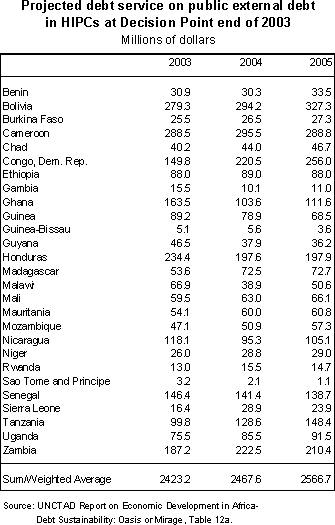
The Report argues a robust economic case for a total cancellation of Africa's debt:
· Low levels of savings and investment leading to high poverty and adverse social conditions are among the biggest constraints on growth in low-income African countries;
· Continuing debt servicing by African countries would nominally constitute a reverse transfer of resources to creditors by a group of countries that by all indications could least afford this; and
· In order to ensure that Africa will be able to reduce poverty by half by 2015, in line with the MDGs, at the very least growth levels will have to double to some 7%-to-8% per annum for the next decade, the financial requirements of which are incompatible with present and projected levels of debt servicing.
And this economic case is reinforced by a moral imperative for a shared responsibility, particularly considering that the BWIs have had the greatest influence on the development policies on the continent through structural adjustment programmes and related lending, which have not had the expected outcomes in ensuring growth and development. Moreover, official lending was in large part also predicated on the implementation of such programmes, and much of the debt of countries with profligate regimes that were of geopolitical/strategic interest is considered "odious".
Over the past two decades, examples have abounded of major bailout operations both domestically and internationally where financial markets were seen to be at risk. While Africa's external debt represents a huge burden to the indebted countries, it has not yet galvanized the political will required by its creditors to undertake similar action.
In the absence of such political will, the Report calls for placing a moratorium on debt servicing (without additional interest being accrued) pending the institution of an independent panel of experts to assess the sustainability of debt based on a realistic and comprehensive set of criteria, including those of meeting the MDGs. The Report recommends that such an assessment should include all public debt. This is particularly so because the Heavily Indebted Poor Countries (HIPC) Initiative fails to take account of domestic debt, which in recent years has become an important factor in the total indebtedness of African countries.
However, even a full debt write-off would be only a first step towards restoring growth and meeting the MDGs. UNCTAD estimates that such a write-off would represent less than half those countires' resource requirements, with the gap filled by increased official development assistance (ODA) grants as a prelude to Africa increasing the level of domestic savings and investment required for robust and sustainable growth.
Meeting the MDGs
It is in this context that the Report concludes that under present conditions, the MDGs will remain elusive for the African continent. As UK Chancellor of the Exchequer Gordon Brown insisted earlier this year, "On current progress, we will fail to meet each Millennium Development Goal in Africa not just for 10 years but for 100 years". That failure can in part be traced to the "unaffordable" debt burden that has strangled the continent's growth prospects for the past two decades, according to Jeffrey Sachs, Special Economic Advisor to UN Secretary-General Kofi Annan. And African leaders, including Ethiopian Prime Minister Meles Zanawi, have begun to ask whether the HIPC Initiative has the capacity to provide adequate debt relief to its beneficiaries.
The HIPC Initiative was launched in 1996 by the BWIs with the aim of reducing the external public debt of the 42 poorest countries (of which 34 are in Africa) to sustainable levels. Calls for "deeper, broader and faster" debt relief led to the introduction of an enhanced version in 1999, which was to make it easier for poor countries to find a permanent exit solution to their debt crisis.
But eight years on, the Report argues, despite some initial progress following the adoption of the enhanced Initiative, heavily indebted poor African countries are still far from achieving sustainable debt levels.
In a forward-looking evaluation, the Report findings include:
· Post-HIPC debt service payments are projected to increase from about $2.4 billion in 2003 to $2.6 billion in 2005.
· Based on historical growth rates, the 23 African HIPCs that reached their decision points by the end of 2003 have only a 40% chance of attaining debt sustainability by 2020.
· While some completion point countries have debt ratios exceeding sustainable levels as defined by the Initiative, a number of equally poor debt-distressed African countries find themselves left out of the Initiative altogether.
· Interim relief (between decision and completion points) is inadequate and falls short of the proportion of the total debt relief that creditors had promised to deliver during this critical period.
· Bias in the debt sustainability analysis - and in particular, persistently over-optimistic assumptions about economic and export growth -- means that calculations of debt sustainability thresholds based on debt-to-export and debt-to-revenue ratios are inadequate indicators of the poverty-indebtedness nexus.
· There is uncertainty surrounding the funding of debt relief, particularly for conflict and post-conflict HIPCs;
· The jury is still out on whether HIPC debt relief is additional to ODA flows. New initiatives are needed to attain a clear and significant level of additionality and to prevent an unfair reallocation of future aid to HIPC debt relief.
In a nutshell, "it is becoming increasingly doubtful whether HIPC beneficiaries can attain sustainable debt levels, based on export and revenue criteria, after completion point, and maintain these in the long term", observes the UNCTAD Report.
Policy space critical
For any debt relief framework to deliver tangible results, Africa needs actively to pursue policies for prudent debt management, economic diversification and sustained economic growth. But doing so calls for better access to markets, much increased investment in human and physical infrastructure and a considerable widening of the policy space narrowed by adjustment programmes, including in the context of poverty reduction strategies.
Printer friendly version
Send page by E-Mail
Haiti's Elections: A High-Tech Sham
Posted: Sunday, October 3, 2004
By Lucson Pierre-Charles
The ouster of Jean-Bertrand Aristide was orchestrated by and for the ruling minority. For two hundred years, they have ruled the country by proxy and have undoubtedly some responsibility to bear for the current state of affairs in the country. However, following Aristide's forced departure, they have decided to change course. They have established a puppet regime of technocrats with the aim of smoothing the progress of a total minority rule and according to latest indications, they are right on target. The technocrats have turned the country upside down. They have transformed the nation into an open theater with farcical promises, farcical disarmament, farcical trials and upcoming farcical elections.
In an attempt to boost its technocratic profile, the U.S.-backed administration--assuming it survives the present chaos--plans to hold digitized elections next year in order to seal a victory for a few. According to a Reuters report released in early August, "Haiti's plans to hold high-tech and costly elections in 2005 are at risk unless international donors rapidly provide promised funds, a senior election official said. Five months after president Jean-Bertrand Aristide was ousted in an armed revolt, Haiti's electoral council needs $100 million to organize what will be the most expensive ballot in Haiti's 200 years of independence, council member Rosemond Pradel said."
The nine-member electoral council (CEP) was created without the participation of the Lavalas party, which decided to boycott it following waves of arrests and persecutions of Aristide loyalists. As the report further indicated, such situation "has undermined confidence in the panel, and especially in the government's plans for a computerized voting system that some analysts fear could be manipulated to prevent Aristide's supporters among the poor majority from determining the outcome. Preparations for the election have been torn by infighting, and the electoral council faces the further challenge of trying to organize high-tech voting with digitized identity cards and electronic voting machines in a country that barely has electricity."
In an effort to appease critics of the plan, council chairwoman Roselaure Julien made a public statement last week in which she announced that an agreement was reached between the CEP and the political parties to forgo the electronic voting machines and retain the digitized ID cards instead. It is only in this status quo that one can envision digital ID cards without digital machines. Her statement, which failed to address the prospect of influencing the outcomes of the election, comes months after a power struggle to control the electoral body was made public. The infighting was so heated that both Boniface and Latortue had to intervene in order to keep the actual makeup of the institution. The clash was intended to bring down Julien and replace her with the actual representative of the private sector, which in turn wanted to have complete control over the high-tech aspect of the upcoming elections. Julien "accused her colleagues of a plot to hijack the electoral process and denounced a fierce power struggle among those who helped oust Aristide and said she had come under pressure to resign because she had resisted attempts to influence her. I won't kneel down, said Julien, I say there should be a free and fair election, not selection, nomination or plebiscite." In such a context, one must assume that the fight to control the CEP will not go away given that the private sector has no way of capturing the presidency except through electronic ballot.
A report released by the Associated Press in late August revealed that "Haiti has signed an agreement with the United Nations and the Organization of American States to organize elections next year and already has US$9 million in U.S. aid available to help cover the costs. The U.S. aid will be spent on training elections personnel, creating a new voter registration system and setting up an electronic voting system." This is why, despite Julien's statement on the rejection of computerized voting machines, American and Venezuelan experts are on the ground conducting demonstrations on the significance and benefits of electronic voting.
Last July, international donors pledged over $1 billion to help rebuild Haiti. The technocrats hope to use part of that money to organize a computerized election where the winners will be pre-selected. Upon receiving the donors' pledge, Latortue promised to double electricity service to 12 hours in Port-au-Prince. So where will his administration find enough energy resources to run a high-tech voting system across the country? Through some technocratic means perhaps. Besides the electricity dilemma, other challenges must also be addressed. In a country where close to 80% of the population are illiterate and basic infrastructures are nearly nonexistent, the idea to run a computerized election is beyond human comprehension. Despite all the uncertainties associated with electronic voting machines--a system terribly unreliable and not accountable--Haiti would be the last place in this region to hold high-tech elections.
In a further attempt to secure the elections, the private sector has launched a new political party, Parti Libéral Haitien (Haitian Liberal Party). The party will run on a conservative platform with the aim of boosting the private sector and promoting a liberal economy, they claimed. To the surprise of the Haitian political class, the announcement was made in Norway during a forum organized and hosted by the Norwegian government for various segments of the Haitian civil society in late August. In the lead-up to the coup against Aristide, the leader of the Group 184, Andy Apaid Jr., promised his allies that he would never transform his movement into a political party. But things have changed lately and the machine has been set in motion. They have the party and the means; the only missing factor is the ballot. They are in no way capable of collecting the necessary votes except through electronic voting, which is also one tangible way to deter people from voting and suppress the majority. Even f voters were to show up to the polling stations, the technocrats are well aware of the challenges that people will face in trying to use the computerized machines. They will probably rely on high-tech poll workers to "assist" the voters. They are not concerned about huge voter turnout; they only need the elections to be held as planned.
Since Aristide's forced departure, the vast majority of Haitians have been marginalized and left with no credible figures to represent their interests. The technocrats have used all tactics in their effort to repress all dissent, to persecute former Lavalas officials and incarcerate them in order to silence the poor majority. In the name of the majority, they are working actively to facilitate a transition that will plunge the endangered nation further into despair. Their ultimate fate lies in their disregard of the country's 200 years history.
Lucson Pierre-Charles, a native of Haiti, now lives in Maryland. He can be reached at: lpierrecharles@yahoo.com. This article was reproduced from counterpunch.org by consent of the author.
Printer friendly version
Send page by E-Mail
Stealing Diego Garcia
Posted: Saturday, October 2, 2004
Our deportation of the people of Diego Garcia is a crime that cannot stand
By John Pilger, The Guardian UK
There are times when one tragedy, one crime tells us how a whole system works behind its democratic facade and helps us to understand how much of the world is run for the benefit of the powerful and how governments lie. To understand the catastrophe of Iraq, and all the other Iraqs along imperial history's trail of blood and tears, one need look no further than Diego Garcia.
The story of Diego Garcia is shocking, almost incredible. A British colony lying midway between Africa and Asia in the Indian Ocean, the island is one of 64 unique coral islands that form the Chagos Archipelago, a phenomenon of natural beauty, and once of peace. Newsreaders refer to it in passing: "American B-52 and Stealth bombers last night took off from the uninhabited British island of Diego Garcia to bomb Iraq (or Afghanistan)." It is the word "uninhabited" that turns the key on the horror of what was done there. In the 1970s, the Ministry of Defence in London produced this epic lie: "There is nothing in our files about a population and an evacuation."
Diego Garcia was first settled in the late 18th century. At least 2,000 people lived there: a gentle creole nation with thriving villages, a school, a hospital, a church, a prison, a railway, docks, a copra plantation. Watching a film shot by missionaries in the 1960s, I can understand why every Chagos islander I have met calls it paradise; there is a grainy sequence where the islanders' beloved dogs are swimming in the sheltered, palm-fringed lagoon, catching fish.
All this began to end when an American rear-admiral stepped ashore in 1961 and Diego Garcia was marked as the site of what is today one of the biggest American bases in the world. There are now more than 2,000 troops, anchorage for 30 warships, a nuclear dump, a satellite spy station, shopping malls, bars and a golf course. "Camp Justice" the Americans call it.
During the 1960s, in high secrecy, the Labour government of Harold Wilson conspired with two American administrations to "sweep" and "sanitise" the islands: the words used in American documents. Files found in the National Archives in Washington and the Public Record Office in London provide an astonishing narrative of official lying all too familiar to those who have chronicled the lies over Iraq.
To get rid of the population, the Foreign Office invented the fiction that the islanders were merely transient contract workers who could be "returned" to Mauritius, 1,000 miles away. In fact, many islanders traced their ancestry back five generations, as their cemeteries bore witness. The aim, wrote a Foreign Office official in January 1966, "is to convert all the existing residents ... into short-term, temporary residents."
What the files also reveal is an imperious attitude of brutality. In August 1966, Sir Paul Gore-Booth, permanent under-secretary at the Foreign Office, wrote: "We must surely be very tough about this. The object of the exercise was to get some rocks that will remain ours. There will be no indigenous population except seagulls." At the end of this is a handwritten note by DH Greenhill, later Baron Greenhill: "Along with the Birds go some Tarzans or Men Fridays ..." Under the heading, "Maintaining the fiction", another official urges his colleagues to reclassify the islanders as "a floating population" and to "make up the rules as we go along".
There is not a word of concern for their victims. Only one official appeared to worry about being caught, writing that it was "fairly unsatisfactory" that "we propose to certify the people, more or less fraudulently, as belonging somewhere else". The documents leave no doubt that the cover-up was approved by the prime minister and at least three cabinet ministers.
At first, the islanders were tricked and intimidated into leaving; those who had gone to Mauritius for urgent medical treatment were prevented from returning. As the Americans began to arrive and build the base, Sir Bruce Greatbatch, the governor of the Seychelles, who had been put in charge of the "sanitising", ordered all the pet dogs on Diego Garcia to be killed. Almost 1,000 pets were rounded up and gassed, using the exhaust fumes from American military vehicles. "They put the dogs in a furnace where the people worked," says Lizette Tallatte, now in her 60s," ... and when their dogs were taken away in front of them, our children screamed and cried."
The islanders took this as a warning; and the remaining population were loaded on to ships, allowed to take only one suitcase. They left behind their homes and furniture, and their lives. On one journey in rough seas, the copra company's horses occupied the deck, while women and children were forced to sleep on a cargo of bird fertiliser. Arriving in the Seychelles, they were marched up the hill to a prison where they were held until they were transported to Mauritius. There, they were dumped on the docks.
In the first months of their exile, as they fought to survive, suicides and child deaths were common. Lizette lost two children. "The doctor said he cannot treat sadness," she recalls. Rita Bancoult, now 79, lost two daughters and a son; she told me that when her husband was told the family could never return home, he suffered a stroke and died. Unemployment, drugs and prostitution, all of which had been alien to their society, ravaged them. Only after more than a decade did they receive any compensation from the British government: less than £3,000 each, which did not cover their debts.
The behaviour of the Blair government is, in many respects, the worst. In 2000, the islanders won a historic victory in the high court, which ruled their expulsion illegal. Within hours of the judgment, the Foreign Office announced that it would not be possible for them to return to Diego Garcia because of a "treaty" with Washington - in truth, a deal concealed from parliament and the US Congress. As for the other islands in the group, a "feasibility study" would determine whether these could be resettled. This has been described by Professor David Stoddart, a world authority on the Chagos, as "worthless" and "an elaborate charade". The "study" consulted not a single islander; it found that the islands were "sinking", which was news to the Americans who are building more and more base facilities; the US navy describes the living conditions as so outstanding that they are "unbelievable".
In 2003, in a now notorious follow-up high court case, the islanders were denied compensation, with government counsel allowed by the judge to attack and humiliate them in the witness box, and with Justice Ousley referring to "we" as if the court and the Foreign Office were on the same side. Last June, the government invoked the archaic royal prerogative in order to crush the 2000 judgment. A decree was issued that the islanders were banned forever from returning home. These were the same totalitarian powers used to expel them in secret 40 years ago; Blair used them to authorise his illegal attack on Iraq.
Led by a remarkable man, Olivier Bancoult, an electrician, and supported by a tenacious and valiant London lawyer, Richard Gifford, the islanders are going to the European court of human rights, and perhaps beyond. Article 7 of the statute of the international criminal court describes the "deportation or forcible transfer of population ... by expulsion or other coercive acts" as a crime against humanity. As Bush's bombers take off from their paradise, the Chagos islanders, says Bancoult, "will not let this great crime stand. The world is changing; we will win."
· Stealing a Nation, John Pilger's documentary investigating the expulsion of the Chagos islanders will be shown on ITV on Wednesday at 11 pm; his new book, Tell Me No Lies: Investigative journalism and its triumphs, is published by Jonathan Cape
www.johnpilger.com
More...
No Place Called Home: Diego Garcia
by Mark Curtis
The Chagos-Diego Garcia scandal on British TV
by Noor Adam Essack
'They stole our homes, then turned us away'
socialistworker.co.uk
Also visit:
diegogarciaisland.mysite.wanadoo-members.co.uk/
Printer friendly version
Send page by E-Mail
Rolling Haiti Back to Colonialism
Posted: Saturday, September 25, 2004
Charles Boylan of Vancouver Co-op Radio interviews Kevin Pina
by Kevin Pina and Charles Boylan; September 21, 2004
Charles Boylan: I saw an e-mail yesterday and it said that the Haitian Army is re-establishing itself. I want you to tell us what you know about these facts, and to tell us a little bit about what this army is and its history.
Pina: Well it's the Forces, d'army Haiti Fad'h, which was the army created by the US back during the first occupation of Haiti, which lasted nineteen years, from 1915 to 1934. The army, traditionally, was a tool of the ruling class of Haiti. It could be bought; it was responsible for more than thirty-three coup d'etats in Haiti's history. During the 1990's, after the coup d'etat against the first government of President Aristide, the army became very deeply involved in drug trafficking. Certainly it's an army that has never had to be used to defend Haiti's sovereignty against any outside force. It's traditionally been a tool of repression for Haitians inside Haiti.
As far as its resurgence [goes], what we know is that members of the former military, as well as members of the former CIA trained paramilitary death squad FRAPH, as well as officers such as Guy Philippe [formerly] of the Haitian police, were given safe harbour by certain segments of the Dominican government and certain segments of the Dominican military. After the year 2000 we know that they began several series' of incursions into Haiti, which led to the assassination of several members of Aristide's Lavalas Party . They would make armed incursions into Haiti and they would then return to their "safe haven" in the Dominican Republic. There have been charges that there's no way that this could have been done without U.S. complicity and the U.S. knowing exactly what was going on.
Certainly, I was reporting about [this]…about two, two and a half years ago. So, certainly if I had that information, it had to be available to the United States government, certainly the U.S. embassy in the Dominican Republic. And, the former military along with these other forces I described, used Dominican territory to launch an attack into Haiti; a larger attack into Haiti in early February [2004], which led to the coup d'etat of the constitutionally elected President, Jean Bertrand Aristide, who was forced out of the country on February 29th of this year.
Boylan: Now, the United Nations forces are there. They're there under [the auspices of] some sort of U.N. Resolution I assume. What is their role in all of this?
Pina: Well, it's been very sketchy. The government claims today that they've re-taken the town of St. Marc. The former military has been regrouping and has been calling for its reinstitution, its recognition and reinstitution to its former role, which is basically, de facto rulers of Haiti, as I said, open to bidding to highest bidder within the traditional ruling bourgeoisie of Haiti. They've taken over much a large segment, a swath of the Northern country, which includes the town of Hinche, the Plateau Central including an area called Morn Kabrit, and the town of St. Marc. The UN and the PNH had announced that they had re-taken St. Marc yesterday, however we have not confirmed that.
What's interesting to note is that the UN 'says' that it is assisting the Haitian police force, and [on] August the 14th, the Lavalas organization, which was Aristide's political party - which has of course has seen tremendous repression since the President's forced ouster on February 29th - on August the 14th, Lavalas held demonstrations in the second-largest city, Cap-Haitien, and in the capital, Port au Prince. In both those demonstrations, the UN and Haitian police had demonstrators tuck their t-shirts into their pants, so they could be sure there were no guns at the demonstration. The very next day, on August 15th, the same UN and Haitian police allowed 150 Haitian military to march openly in the capital of Port au Prince, brandishing M-16s, M-14s, a few M-60s, and they were not challenged at all. So, if indeed the UN are beginning to challenge the former military, it's a brand new phenomenon.
Many people who are in Lavalas who, as I said, have been victims of this campaign of repression since Aristide's forced ouster of February 29th, really see themselves as now being caught in a pincer movement between two forces. One is the Haitian National Police - backed up by the United Nations forces - and on the other side is the former military who are trying to come back into power. Now, it's really interesting to note that the United States has worked with the current so-called "interim government"; Lavalas refers to it as 'de facto' government, the U.S. installed government of Gerard Latortue, to now talk about integrating a 1000 of these former military soldiers into the Haitian National Police. Well, they'd already started this process beginning back in March; it really doesn't make sense for them to that they say they're not going to allow the former military to be restored to its former role while at the same time they're virtually transforming the Haitian National Police into an entity that contains a large percentage of those same former military.
Boylan: When you speak this way about this pincer movement my mind flashes back to the tragedy of Lumumba in the Congo 'way back in 1960's,' you had the same sort of intervention by the U.N. on the one side and you had the Chambe [Mobutu's] reactionaries on the other. It's hard to make these parallels of course but it seems to me you have the U.N. sort of playing a duplicitous role here. The original invasion of course was by the United States, Canada, and France. Have all of their forces left the island now?
Pina: I still see smatterings of Canadian troops; there are some French forces here that are laying low; there is still a small contingent of U.S. Marines. But mostly it's the Brazilians, the Chileans and the Argentineans, who are taking the lead. Certainly, I believe that the role of the French and the U.S., and the Canadian is at this point a leadership role within the command structure of the U.N. forces. It's also interesting to note that there's a new level, a new wave of repression that began this last Sunday. Now remember that the U.N. forces claims that they are assisting the Haitian police. This includes even if the Haitian National Police are performing an action at the behest of the Latortue government, which may be based upon a lie, as in the case of So Anne, who is a popular folk singer, who's home was violently invaded by U.S. Marines on May 10th and she herself was arrested by the U.S. Marines, based upon an accusation of the Latortue government, that she was planning to attack U.S. forces.
So, the UN will back up the Haitian police even if the Haitian police from the Latortue government are performing an action that is based upon false information, false information that they know is false. This last Sunday, the Haitian National Police began to indiscriminately round up all adult males in several popular neighbourhoods where Lavalas support is known to be great. On Sunday they arrested more than sixty males in a neighbourhood just North of the capital, and yesterday they arrested another thirty in a neighbourhood called St. Martin. Sunday, the police would come in, and they would create this net around the neighbourhood and then they would indiscriminately round up all adult males who were caught in the net without any cause or justification. Always lingering in the background are large APV vehicles with heavily armed United Nations troops. I guess they are [there] to ensure that no one will resist the Haitian police while they are performing this broad procedure of indiscriminate detainment and arrest in popular neighbourhoods where Lavalas support is known to be greatest.
Boylan: Can you go into a little more detail about the current level of political prisoners in Haiti's penitentiaries, and also put into context this issue acquittal of known murderer Louis Jodel Chamblain, who is one of the "rebels" we read about in early February?
Pina: The Inter-American Human Rights Commission was just in Haiti; they represent the OAS, and of course Amnesty has had several of its researchers on the ground, on and off, as well as Human Rights Watch. Pretty much everyone is in agreement that besides the 'high-profile' Lavalas political prisoners, such as Prime Minister Yvon Neptune, and interior minister Jocelyn Privert, and, as I said earlier, So Anne – Annette - Auguste, this famous Haitian folk singer, there are a lot of lesser known people affiliated with the Lavalas party who are currently filling the jails, not only just in the capital of Port au Prince, but also in places like Cap Haitien. I still receive daily calls from people who ask me - because I'm known as a journalist on the ground - if I can put them in touch with human rights organizations; some of them have been wasting in jail since early March without any trial.
The Haitian Constitution says that people should be brought before a judge and charges should be brought before them after forty-eight hours, but there are people who have been in jail for months and months without any charges never seeing a magistrate or a judge. The jails right now are said to be chalk full of people who are affiliated with Lavalas, who consider themselves to be political prisoners. It is interesting that Jodel Chamblain, who was the second in command of the FRAPH [the Front for Advancement and Progress in Haiti], which was the CIA-trained paramilitary death squad responsible for thousand and thousands of deaths following the 1991 coup against Jean Bertrand Aristide, and who was seen by eyewitnesses to be the trigger man who assassinated a leading businessman and Aristide supporter Antoine Izmery on September 11th, 1993…
The trial was obviously a sham, human rights organizations have rightfully condemned it; it's interesting to note that while Jodel Chamblian was given his 'day in court' as was Jackson Joanis who was the former head of anti-gang, who was also implicated in the murder of Antoine Izmery. Annette Auguste, Prime Minister Neptune and Interior Minister Jocelyn Privert, have had just these cursory visits to the court, and then nothing has been done, they've just been left without word of when their next hearing will be, whereas with someone like Jodel Chamblain is given an immediate trial where eight witnesses are called, seven of the witnesses are frightened out of their minds and will not come to the hearing. Only one shows up and he says nothing about the incident, and the jury deliberates in the middle of the night in secret for fourteen hours and the man is acquitted of this horrendous crime; clearly there is an inequity, there is not an equal application of Haitian law and the Haitian Constitution. But again I think that's to be expected when you have a government that is more beholden to Washington, and to Ottawa, and to Paris, then it is to its own people, and its own constituency. Remember, this government that's in power now has never withstood the test of democratic elections; it's in power by virtue of the role that those three nations played in overseeing the forced ouster, if you will, of the Constitutionally elected President Jean Bertrand Aristide on February 29th of this year.
Boylan: Well, this puts the question on the whole constitutionality of the validity of the invasion in the beginning, and I'd like you to speak, if you will, to a Canadian audience, of what you know about Canada in this whole affair.
Pina: It is clear that Canada played a very pivotal role in terms of backing and going along with U.S. foreign policy. Certainly the Canadian government, I would say in, a lot of ways, lacked backbone, at best, and, at worst, were openly complicit with this ouster of Constitutionally, democratically-elected president [Aristide]. But to go to the particulars of what happened on February 29th, you've got to remember that Canada has towed the line of the U.S. government that there these armed rebels threatening the capital. Well, this is just complete nonsense. It was very clear how this theatre went down.
Foreign embassy after foreign embassy, beginning with the Italian embassy, who were then followed second by the Canadian embassy and other European embassies demanded that all their citizens flee Haiti and that hit the headlines big: "Foreign Nationals Flee Haiti" And the n finally the United States demanded that its citizens flee Haiti and that hit the headlines big: "U.S. Citizens Flee Haiti." You know, President Aristide and Lavalas had been condemning these armed incursions I had spoke about earlier, by the former military, by the former paramilitary death squad, FRAPH, from the Dominican Republic into Haiti, in which they were killing Lavalas officials and then returning to the Dominican Republic. They'd been condemning this for years, and their condemnations had been falling upon deaf ears in the [corporate] press.
Suddenly, Guy Philippe and these guys show up in the country, and all of these [corporate news] editors fall over themselves to find budgets, including sending your dear Paul Knox from the Globe and Mail out here. Suddenly they've got these budgets, per diems, and transportation expenses to send these reporters out to fall all over themselves to cover this 'huge story' of the rebels. When, as I said, Lavalas had been condemning and talking about these people being in the Dominican Republic for years, and it was falling upon deaf ears and the press never had any attention span for it or interest in it, whatsoever. Suddenly, they discover them 'by miracle' and its this huge headline, and as I said this is compounded by this theatre of foreign embassies demanding that their nationals leave, ultimately leading to the U.S. embassy demanding its nationals leave.
The very next day 50 armed U.S. Marines arrive into Haiti, into the capital, flown in a big flurry on a big transport plane, purportedly to check on the security preparations at the U.S. embassy, and then the next bead in this story, this theatre if you will, is that, suddenly, the Toussaint L'Ouverture airport is closed to all airport traffic. Now, you've got to remember that not a single foreign national in this entire time ever had a scratch or a hair touched on his head. Nor was there ever a single shot fired at the airport, and that's what leads myself and many others who were here, who experienced this, to believe that this was just a superb theatrical performance that was being led by France, Canada, and the United States to give the perception of these "dire" circumstances, to give the perception of this 'embattled dictator' Aristide, who had to 'cling to power' by virtue of these violent forces, his 'minions' of his party of Lavalas.
And, by the way, they [Aristide's supporters] were in the streets, and they were trying to protect the capital, and that's why I say that this threat that the U.S. government said forced Aristide out of office, that the rebels were going to enter the capital, was a non-threat, because there was no way that 200, or even 300 heavily armed men could have entered this capital at any time without heavy house to house fighting and heavy resistance. It's just a lie and a non-threat.
What you also have to remember that at the exact moment that those 50 U.S. Marines who entered Haiti under the auspices of checking the security preparations at the U.S. embassy; at the same moment that they were entering Aristide's residence, to take him out of office, to force him onto that airplane to Bangui, in the Central African Republic; at this very same moment there was a large transport plane on the tarmac in Jamaica, refuelling, that was carrying re-supplies of arms and ammunitions for the Haitian police force. This was not, as the U.S. and Canada, and the French presented, a President who was "resigned to his fate." This was a President, who because that transport plane was being sent in a unilateral assistance agreement with the government of South Africa, with the re-supply of arms and ammunition for the Haitian police force, and as I said at the same moment the President was being taken out by the U.S. Marines, that same plane was refuelling on a tarmac in Jamaica; that was why they had to take him out, because, quite the contrary to the image they portrayed of this man who was resigned to his fate, who had lost the support of his people; this was a man who was willing to fight for the sovereignty, was willing to fight to continue his democratic mandate.
Boylan: This is a very telling story; I don't think that's been broadcast here, that's for certain. That aspect of the story; we were all left wondering, 'Why did Aristide leave? What the hell was going on? And of course we were all left in the dark by the mass media manipulation of the airwaves. This is an extremely important chapter. Tell us a little bit more about this story, tell us a little bit about the circumstances facing you and all those who are trying to bring light to what is actually happening in Haiti, and what oppositional forces, internationally, locally, are putting some weight behind the Haitian people in this dark moment of their history?
Pina: Well, you've got to realize is that it was a huge campaign of disinformation that demonized Lavalas and demonized Aristide, and this is still going on today. They use buzzwords like 'chimere,' which is a term that they call Lavalas who defended themselves, or who defended the government. They've painted Aristide as a 'dictator' who 'lost the support of his people,' who was relying upon his Lavalas 'shock troops.' They've really presented this dark image of what was essentially, what is essentially, a movement of the majority of the poor in this country, they continue [to demonize] to this day.
There has been so much misinformation, and so many lies; the Haitian press participated in it: they fed stories to the international press, and the international press fed it back to them, and suddenly what was innuendo and rumour gets 'transformed' into reality and suddenly reality gets turned on its head, and a lot of what I read [in the press] about Haiti is the exactly the reverse of what I myself and many others who live this reality day to day; what we experience and how we see the situation. Today the Haitian press still plays an horrendous role; the standard of journalism and what passes for the truth, and what passes for professionalism is just abhorrent.
The major news outlets here are owned by large families who are aligned with the elite, or are members of the small economic elite themselves, it's clear that they've had a large role in this movement to overthrow Aristide; it's clear that they'd spent a tremendous amount of money in public relations, whether that be over the internet, in the U.S. press, the French press, the Canadian press. And the U.S. corporate media in general, as I said, presenting this image of the movement of the poor in a very ugly and, I would say, false light. It's not to say that, certainly, there weren't errors made by Aristide; it's not to say that there weren't people amongst the masses of the poor who weren't angry, and who ultimately felt cornered and that they had no resort except to violence. But you've got to remember, and not to apologize for it or excuse it, we have to understand that this really a response to people who knew that this was going to happen, that their greatest enemy who was this corrupt, dangerous, murderous institution, the Haitian military, was being poised to return to this country. They knew that a year ago, and of course how can you expect people who's mothers were raped, whose brothers and fathers were brutally murdered, whose sisters were murdered, not to react very emotionally and in some instances violently, knowing that this was going to happen, that the Haitian military was being poised for an eventual position of return to Haiti?
A lot of what was twisted and said to represent the evil 'shock troops,' the chimeres of the dictator Lavalas, was the righteous indignation and anger of a very, very frightened mass of poor people in this country who for the first time had a government that they felt represented their interests. All you have to do today, with what is going on with this U.S. backed government, this U.S. installed government, by virtue of this action that the U.S., France, and Canada pulled in Haiti, you see that there was a Ministry of Literacy under the Aristide administration, that was one of the first ministries abolished. Literacy, and the majority of the poor learning to read and write is not a priority for this [de facto] administration.
There was public housing that was built where poor families could rent an apartment but their rent would be applied for equity to allow them for the first time to own an apartment or a condominium, that was a decent home with running water and electricity, that was something modern. Now, that housing is being taken over by this government to give to U.N. officials for their own personal housing. Imagine, housing that was built for the poor is now being taken over by this U.S. installed government, to turn over to United Nations workers, and the peacekeeping force, their commanders, so that they can live in them while they are displacing and evicting the poor, who, for the first time, had housing. These are just a few examples to show you what the priorities are now versus what the priorities were. It seems that you only really get to really understand what was really going on before by seeing it being dismantled today.
Another point is the agrarian reform. Everybody always said that there was never any effort to help the majority of the poor who are peasants in the countryside; seventy per cent of Haiti's population are poor peasants living in the countryside. Well, it's only today when we are seeing the agrarian reform being dismantled, under this U.S. installed government, the former landowners are returning and taking back the land that was distributed to the peasants under the Agrarian Reform Act, that we understand that there really was was an agrarian reform project. That huge propaganda campaign, the people who control the press said that agrarian reform program never existed, and the only reason we can see today that it clearly existed is that now the peasants are fighting back and there's open violence now, and rebellion by peasants in the countryside against these large landowners returning to re-claim the land that was distributed to them under the agrarian reform that was started first under the Preval administration, and then continued under the Aristide administration.. These are examples of projects that clearly benefited the majority of the poor, that people said never existed, that the corporate media completely ignored and only focussed on stories that were fed to it buy the elite-controlled media that focussed on these negative acts of violence…[disconnects…]
Boylan: Listeners must be very angry as they listen to the things you are enumerating, listing off these facts that are brand-new to most people. What can we do about it, how can we empower ourselves to affect change, and [to help] restore democracy to Haiti?
Pina: I think that it's got to start with our own governments. I was very proud of Congresswoman Maxine Waters, who [recently] called out Washington, Paris, and Ottawa by name today. She said, 'they're the ones who created this mess, they're the ones who are responsible to clean it up.' I think she's absolutely right, that we have to hold our governments accountable, that we need to [exert] pressure, even though the media, which has played such a terrible role in all of this, particularly the corporate media: These are large businesses, these are people who get called up buy the prime minister's and the presidents and the secretaries of this and that, and have the news influenced and shaped for them. These are the people who would rather call the Embassy first to get their reaction, then to risk their necks out on the street to try to get the reaction of the average poor person.
So, they've played a terrible role; right now they are conspicuously silent, they've done their damage, so what means is that we have to rely upon our own education networks, that means that we have to create our own sources of reliable information, that we need to cherish those sources, we need to support those sources, and we need to use that information that we get from those sources that we trust, to then leverage it against our elected officials, in order to get them to stand up, to put this issue back on the burner again, where it belongs. To get them to take responsibility for what they have done in this country, and what they have done to this country. Certainly what has gone down in Haiti falls right at the doorstep of Mr. George Bush, the Junior. I'm certain that right now this is not an issue in the election, but there are people who are trying to make it an issue in the election, particularly when we see, in a lot of ways, the U.S. you know played the leadership; I don't mean to cut Canada down, but they've really sort of been the lackeys, and the lapdogs, if you will, of U.S. foreign policy in this. I'm not trying to say that they weren't smart enough to do their own damage, but you know it's pretty much the U.S. that's called the shots on the ground here and Canada has pretty much saluted and said 'yes sir, whatever you need?'
The French played a more of a public leadership role on the ground; but Canada certainly had a definite role, and certainly the Canadian people should take responsibility to pressure their elected representatives, to put this issue back on the burner and to force them to restore democracy to Haiti, first of all. This is not a government that has been tested by the polls and it doesn't look as if the next elections in Haiti are going to allow the majority political party, who, as we discussed earlier, has been violently repressed, has been subject to mass arrests and mass detentions, is caught in this pincer movement between the violence of the Haitian police committed against them backed up by the United Nations, and the violence of the dreaded former military; they're not going to be able to participate in a free way in the next elections. So those elections are not really going to represent the will of the majority of the Haitian people either.
What I can say is that people should watch closely, because I think that this popular movement is not going to go gentle into that good night. We see it beginning to reassert itself again; we see that people, despite this tremendous atmosphere of a witch-hunt, despite this tremendous atmosphere of political persecution and intimidation, are still continuing to fight for their rights, still continuing to fight for their right for themselves to be part of a Party that represent the voice of the majority of the poor of this country. That's what we need to be watching for, keeping our pulse for, to know who to support on the ground. The NGOs, by and large, play a very evil role in this country. Certainly they played part and parcel right into this campaign to overthrow the democratic government of Haiti. Remember that Haiti saw its first peaceful transitions from one President to another under the Lavalas Party…
Boylan: I'm sorry to tell you this but times up. Kevin, this has been very enlightening and very, very helpful for our audience to listen to this information; and we will definitely be back in touch; thank you very much for joining us. This has been very helpful, and I want to thank-you for joining us.
Pina: It's been my pleasure.
*This interview was conducted on September 8, 2004. For more information, please go to Wake Up With Co-op. Boylan also hosts "Discussion," Wednesday evenings at 7:00 PST. Kevin Pina is an independent journalist, filmmaker, is Associate Editor of the Black Commentator, and currently resides in Haiti.
Reproduced from:
http://www.zmag.org/content/print_article.cfm?itemID=6276%20§ionID=55
Printer friendly version
Send page by E-Mail
Share your views on the Online Forums
View last 5 days / Advance search
